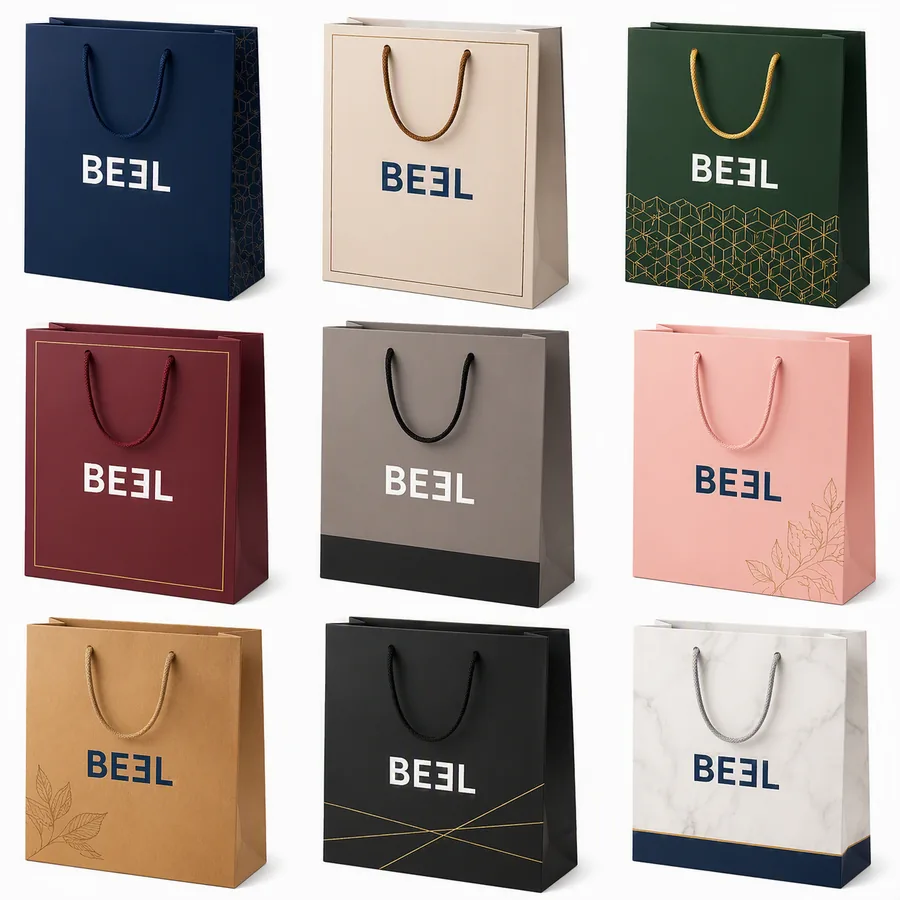
Most of the paper bag enquiries we get in October sound the same. A boutique owner or a retail chain's purchase person sends a photo of a bag they liked at a mall store, asks for "the same, with our logo", and wants a price by evening. When we ask about GSM, handle type or how heavy the product inside is, the reply is usually "you tell us".
That is fair. Nobody outside a converting unit should have to know the difference between 120 GSM kraft and 170 GSM art paper. But those details decide whether the bag costs Rs 9 or Rs 28, how soon it tears at the handle, and if your logo prints sharp or looks muddy on brown paper.
This guide is what we explain on the phone, written down once. It covers the paper grades we use for custom printed paper bags, real price bands at 500 to 10,000 pieces, print methods, handle choices, lead times, and the mistakes that cost first-time buyers money. We make these at our Mumbai unit alongside our fabric bags, so the numbers come from our own floor, not a catalogue.
What a custom printed paper bag is actually made of
Every paper bag is three decisions: the paper, the handle and the print. The paper is the one that drives cost and strength the most, so start there. In India almost all retail paper bags are made from one of three base materials, and each comes in a range of GSM (grams per square metre, the weight of one square metre of the sheet).
Brown kraft is the workhorse. It is made from unbleached pulp, has long fibres and good tear strength for its weight, and it is the cheapest per kilo. White kraft is bleached kraft. It is a little weaker than brown at the same GSM but gives cleaner colour when printed. Art paper or art board is a coated sheet with a smooth surface, usually laminated after printing. This is what you see in jewellery stores, apparel brands and gift counters, the bags with a matte or gloss finish and rope handles.
Here is how we match GSM to use. These are the grades we suggest most often, not hard rules, and a heavy product always pushes you one step up.
| Paper and GSM | Typical use | Rough safe load | Our comment |
|---|---|---|---|
| Brown kraft 80 to 90 GSM | Medical stores, bakeries, takeaway counters | 1 to 2 kg | Fine for light items, usually flat or no handle |
| Brown or white kraft 100 to 120 GSM | Garment stores, bookshops, pharmacy chains | 2 to 4 kg | The most common retail spec we make |
| Kraft 130 to 150 GSM | Footwear, grocery, boxed products | 4 to 6 kg | Add a bottom board for shoe boxes |
| Art paper 170 to 210 GSM, laminated | Boutiques, jewellers, cosmetics, gifting | 2 to 4 kg | Bought for looks; strength comes from lamination and board |
| Art board 250 to 300 GSM, laminated | Premium gifting, liquor, corporate hampers | 4 to 7 kg | Rigid, holds shape on a shelf, costs the most |
The load figures assume a properly glued bottom, a reinforcement strip under the handles and the weight sitting flat. Put a sharp-cornered box in a 100 GSM bag and it can punch through at well under the number above.
Kraft, white kraft or laminated art paper: picking the right one
We usually ask one question first: does the bag need to sell the brand, or just carry the product home? If it is a pharmacy, a grocery store or a takeaway counter, brown kraft with a one-colour logo does the job and keeps the per-piece cost low. Customers expect brown paper there and nobody judges it.
For a clothing brand or a mid-range boutique, white kraft is often the sweet spot. You get bright colours and a clean look without paying for lamination. A two-colour print on 120 GSM white kraft with twisted paper handles is probably the single most ordered bag on our paper line.
Laminated art paper is for brands where the bag is part of the product. Jewellers, perfume and cosmetics stores, designer labels and corporate gift programs fall here. Matte lamination feels expensive and hides fingerprints. Gloss lamination makes colours pop but scuffs and shows every crease. If you want gold foil, a matte base shows it off better. You can see the finishes on our premium matte paper bags and gold foil gift bags pages.
A note on recycled and "eco" claims
Paper bags are recyclable, but a laminated art paper bag with rope handles and metal eyelets is harder to recycle than plain kraft, because the plastic film and handles have to be separated. If sustainability is the main reason you are switching, plain kraft with paper handles and water-based ink is the honest choice. We say this to buyers even though laminated bags earn us more per piece. For a wider view of material options, our eco-friendly bags buyer's guide compares paper with jute, cotton and rPET.
Handles decide whether the bag survives the trip home
We have seen good bags fail because of bad handles more often than bad paper. The handle is where all the load concentrates, and the glue joint between handle patch and bag wall is the weak point. Here are the options we make, from cheapest to most premium.
- Flat paper handles: a folded paper strip glued inside the top. Cheap and machine-made, good for light loads up to about 3 kg. Common on food and pharmacy bags.
- Twisted paper handles: a twisted paper cord glued in with a patch. Comfortable to hold, stronger than flat, and fully paper so it stays recyclable. Our default for kraft retail bags.
- Die-cut handles: a hole punched through a folded, reinforced top. Clean look, no extra parts, but uncomfortable above 2 kg.
- Cotton or PP rope handles: knotted through punched holes, often with eyelets. Standard on laminated art paper bags. PP rope is cheaper and comes in more colours; cotton rope feels softer.
- Satin or grosgrain ribbon: for jewellery and luxury gifting. Looks lovely, adds cost and hand labour, and is the weakest of the lot for heavy items.
One small detail worth asking any supplier about is the reinforcement card at the top fold. On rope-handle bags we insert a strip of board inside the top turn so the knot does not pull through. Skip it and the bag will look fine at sampling and tear at the till.
Custom printed paper bags price: what you will actually pay
This is the section most people scroll to first, so here are honest ranges. They are ex-factory Mumbai, before GST and freight, for a standard retail size of roughly 10 x 4 x 13 inches (about 25 x 10 x 32 cm). Your final quote depends on exact size, paper rates that month, print colours and quantity.
| Bag type | 500 pieces | 2,000 pieces | 10,000 pieces |
|---|---|---|---|
| Brown kraft 100 to 120 GSM, 1-colour print, twisted paper handle | Rs 11 to Rs 16 | Rs 8 to Rs 12 | Rs 6 to Rs 9 |
| White kraft 120 GSM, 2-colour print, twisted paper handle | Rs 13 to Rs 18 | Rs 10 to Rs 14 | Rs 8 to Rs 11 |
| Art paper 170 to 210 GSM, 4-colour print, matte lamination, rope handle | Rs 18 to Rs 25 | Rs 14 to Rs 20 | Rs 11 to Rs 16 |
| Art board 250 GSM, matte lamination, gold foil logo, rope handle | Rs 22 to Rs 30 | Rs 17 to Rs 24 | Rs 14 to Rs 19 |
Notice how sharply the price falls between 500 and 2,000 pieces. Most of that is setup cost: plates or screens, foil blocks, die-cutting tools and machine make-ready get spread over more bags. If you will use 2,000 bags over six months, ordering them in one run almost always beats two runs of 1,000. Our bulk pricing page shows how this works across our other bag lines too.
What pushes the price up
- Non-standard sizes that waste paper on the sheet or need a new forming setup
- Full-bleed prints that cover the whole bag, especially on both sides and gussets
- Foil stamping, spot UV or embossing (each one is a separate pass)
- Ribbon handles and hand-finished details
- Very short deadlines that force overtime or split production
Where you can save without hurting the bag
Print the logo on one side only for takeaway and pharmacy bags. Keep the colour count to two. Pick a size close to one we already run so we avoid fresh tooling. And stay at 120 GSM for apparel unless you sell denim or footwear; going to 150 GSM adds roughly a rupee a bag without much benefit for a shirt.
Printing methods for paper bags and when each makes sense
The printing method affects cost, sharpness and how many colours you can afford. Paper takes ink very differently from non-woven or cotton, so a method that suits a fabric bag is not always right here.
| Method | Best for | Sensible minimum | Watch out for |
|---|---|---|---|
| Flexo printing | 1 to 2 colour logos on kraft, high volumes | 5,000+ pieces | Plate cost; fine detail can spread on rough kraft |
| Screen printing | Bold 1 to 3 colour logos, short runs | 500 pieces | Each colour is a separate screen and pass |
| Offset printing | Photographs, gradients, full-colour art on art paper | 1,000 to 2,000 pieces | Printed on flat sheets before forming, so plan bleed carefully |
| Hot foil stamping | Gold, silver or rose gold logos on laminated bags | 500 pieces | Needs a metal block; thin lines under 0.3 mm may not hold |
| Spot UV or embossing | Premium texture on a matte base | 1,000 pieces | Adds a pass and a few rupees; worth it only on art board |
For short runs of 500 to 1,000 kraft bags, screen printing is usually our recommendation. Above 5,000 pieces, flexo gets cheaper per bag. For full-colour designs with photographs, offset on art paper is the only way to get it right. If you want to see how logo placement and print sizes compare across materials, the logo printed bags page has examples from our fabric lines that apply here as well.
Artwork tips that save a round of corrections
Send vector files (AI, PDF or CDR) with fonts outlined. Give Pantone references if colour matters, because the same orange looks different on brown kraft, white kraft and coated paper. On brown kraft, white ink under a colour (an underbase) brightens it but adds a screen. Keep logos at least 15 mm away from folds and the gusset crease, or they will bend into the side of the bag.
Sizes Indian retailers order most often
Paper bag sizes are written as width x gusset x height. The gusset is the side depth that lets the bag stand and expand. These are the sizes we cut most, which also tend to be the cheapest because the tooling is ready.
- Small, 6 x 3 x 8 inches: jewellery, cosmetics, mobile accessories, sweets boxes
- Medium, 10 x 4 x 13 inches: shirts, kurtis, books, pharmacy orders (our standard size)
- Large, 13 x 5 x 16 inches: folded sarees, trousers, two or three garments
- Extra large, 16 x 6 x 18 inches: shoe boxes, bedsheets, gift hampers
- Wine or bottle, 4 x 4 x 14 inches: one bottle, usually art board with a rope handle
A good test: put your largest regular product in the bag and leave about two inches above it. Customers fold the top or stuff tissue in, and a bag that fits exactly ends up torn at the corners. Most stores do fine with two sizes, a medium and a large.
Paper bags vs non-woven, jute and cotton for retail
Paper is not always the right answer, and we make all of these, so we have no reason to push one. Paper wins on print quality, a premium feel at a low price and recyclability. It loses on rain, reuse and heavy loads. A paper bag gets used once or twice. A non-woven bag gets used a dozen times, and a jute bag or cotton tote can last years, which matters if you want your logo walking around the city for months.
Our rough rule for retail: under Rs 1,500 basket size, paper or non-woven. Above Rs 5,000, a laminated paper bag or a printed cotton or canvas tote if you want reuse. For festive gifting, many brands do both, a paper bag at the counter and a fabric gift bag for top customers. We compared fabric options in detail in non-woven vs jute vs canvas bags, and the retail shopping bags wholesale guide covers the counter-bag side for chains.
One thing we tell grocery and kirana buyers directly: if your customers carry 5 to 8 kg home and it is monsoon, paper will disappoint you. A 75 to 90 GSM non-woven loop bag costs about the same and holds up better. Our non-woven GSM and compliance guide explains what is permitted.
Rules worth knowing before you switch to paper
A lot of the demand for paper bags in Mumbai started with the state's 2018 ban on single-use plastic carry bags, and it picked up again when the central government's ban on identified single-use plastic items came into force on 1 July 2022. Under the Plastic Waste Management Amendment Rules, 2021, plastic carry bags also had to be at least 120 microns thick from 31 December 2022. That made thin plastic bags both illegal and harder to source, and most shops we supply moved to paper or non-woven around then.
If your bag will touch food directly, for example bakery bags, sweet shop pouches or takeaway sacks, the paper has to be food grade. The Food Safety and Standards (Packaging) Regulations, 2018 require paper meant for direct food contact to be food grade, and FSSAI has repeatedly told vendors not to use newspaper to wrap or serve food. In practice, for food contact we use virgin kraft with food-safe ink on the outside only. A carry bag that holds a sealed sweet box is a different case, because the food never touches the paper. Tell us which one you need when you enquire.
We are a manufacturer, not a legal advisor, so if you are a large chain or an exporter, check the current rules for your state and your product category. For buyers sending bags abroad, the rules in the destination country matter more; the import guide for overseas buyers covers that side.
Mistakes we see on first paper bag orders
After a long time making bags, the same handful of problems come up with new buyers. None of them are expensive to avoid if you know about them before you approve a sample.
Approving the digital mock-up and skipping the physical sample
A screen shows colours in RGB light. Kraft paper absorbs ink and darkens it. A bright red logo can look maroon on brown kraft. We always offer a physical sample or a print proof on the actual paper for orders above 1,000 pieces. It adds three or four days and saves a lot of arguments later.
Choosing GSM on price alone
Dropping from 120 to 90 GSM saves around a rupee or a little more per bag on a medium size. If the bag then tears for one customer in twenty, that rupee was not worth it. Test the sample with your heaviest real product and walk around with it for ten minutes.
Ordering for the festival peak at the last minute
October and early November are our busiest weeks for paper bags because of Diwali and the wedding season. Paper stock, lamination and foil slots fill up. A 10 to 15 working day lead time in June can stretch in late October. If you need bags for the festive rush, confirm artwork at least three weeks ahead. Our Diwali corporate gifting bags guide has a fuller planning calendar.
Who we make paper bags for
Most of our paper bag orders come from four kinds of buyers. Clothing and saree stores want medium and large white kraft or laminated bags with a two-colour logo; our bags for retail stores page lists what we supply them alongside paper. Jewellers and gifting businesses want small art paper bags with foil, often paired with jewellery pouches inside. Corporates want branded corporate gift bags for Diwali hampers, client gifts and event giveaways. And pharmacy and food chains want plain kraft in volume.
Wedding planners and families are a growing group too. A laminated paper bag with the couple's initials in foil is a common way to hand out return gifts, and it costs far less than a fabric pouch. Our wedding return gift bags guide covers sizes and timelines for that.
We ship across India from Mumbai. Local buyers in the city and MMR can visit the unit to check samples; details are on the bag manufacturer in Mumbai page. Every batch goes through the same quality control checks as our fabric bags: glue strength at the bottom and handles, print registration and a random load test from each carton.
How to order custom printed paper bags from us
The process is simple, and most orders go from first message to dispatch in about three weeks.
- Share the basics: quantity, approximate size or the product it will carry, paper preference if you have one, number of print colours, and your deadline. WhatsApp or the contact form both work. A photo of a bag you like helps a lot.
- Get a quote: we usually reply the same working day with two or three options at different price points, so you can compare kraft against laminated or one colour against two.
- Artwork and proof: send your logo file. We return a dieline with the artwork placed to scale on every panel. You approve or ask for changes.
- Sample: for orders above 1,000 pieces, or whenever colour matters, we make a physical sample on the actual paper. Plan three to five working days for this.
- Production: after approval and advance payment, production takes about 10 to 15 working days for most specs. Foil and spot UV jobs can need a few days more.
- Dispatch: bags are packed flat in cartons of 100 to 250 depending on size, and sent by transport or courier anywhere in India. Mumbai deliveries usually go in our own tempo.
Our minimum for custom printed paper bags is 500 pieces per design and size. The minimum order quantity page explains how MOQs work across our other products if you want to combine paper bags with fabric bags in one order. First-time importers or bulk buyers can also read how to order wholesale bags in India for the payment and documentation side.
Frequently asked questions
What is the minimum order for custom printed paper bags?
500 pieces per design and size. Below that, setup costs make the per-piece price unreasonable. You can split a larger order across two sizes with the same artwork.
How much does a custom printed paper bag cost in India?
At our factory, a medium brown kraft bag with a one-colour logo runs roughly Rs 6 to Rs 16 depending on quantity. A laminated art paper bag with full-colour print and rope handles runs roughly Rs 11 to Rs 25. Foil and rigid board add more. GST and freight are extra.
Which GSM is best for a retail paper bag?
For clothing and general retail, 100 to 120 GSM kraft is right for most stores. Go to 130 to 150 GSM for footwear or heavy boxed goods. For premium laminated bags, 170 to 210 GSM art paper is standard, and 250 GSM board for rigid luxury bags.
How long does production take?
About 10 to 15 working days after artwork approval for most orders, plus three to five days if you want a physical sample first. During the Diwali and wedding rush, give us an extra week.
Can paper bags be used for food?
Yes, if the paper is food grade and the food touches only unprinted surfaces. Tell us at the enquiry stage so we use food-grade kraft and keep ink on the outside. For sealed boxes inside a carry bag, standard kraft is fine.
Are laminated paper bags recyclable?
Less easily than plain kraft, because the film has to be separated from the paper. If recyclability is your main goal, choose plain kraft with twisted paper handles and water-based inks.
Do you deliver outside Mumbai?
Yes, across India by transport or courier, and we export too. Freight is quoted separately based on carton count and destination.
If you have a size, a logo and a rough quantity in mind, send them over and we will come back with two or three priced options, usually within the working day. You can reach us through the contact page or on WhatsApp at +91 86525 70502. A photo of a bag you like and your deadline are enough to get started.