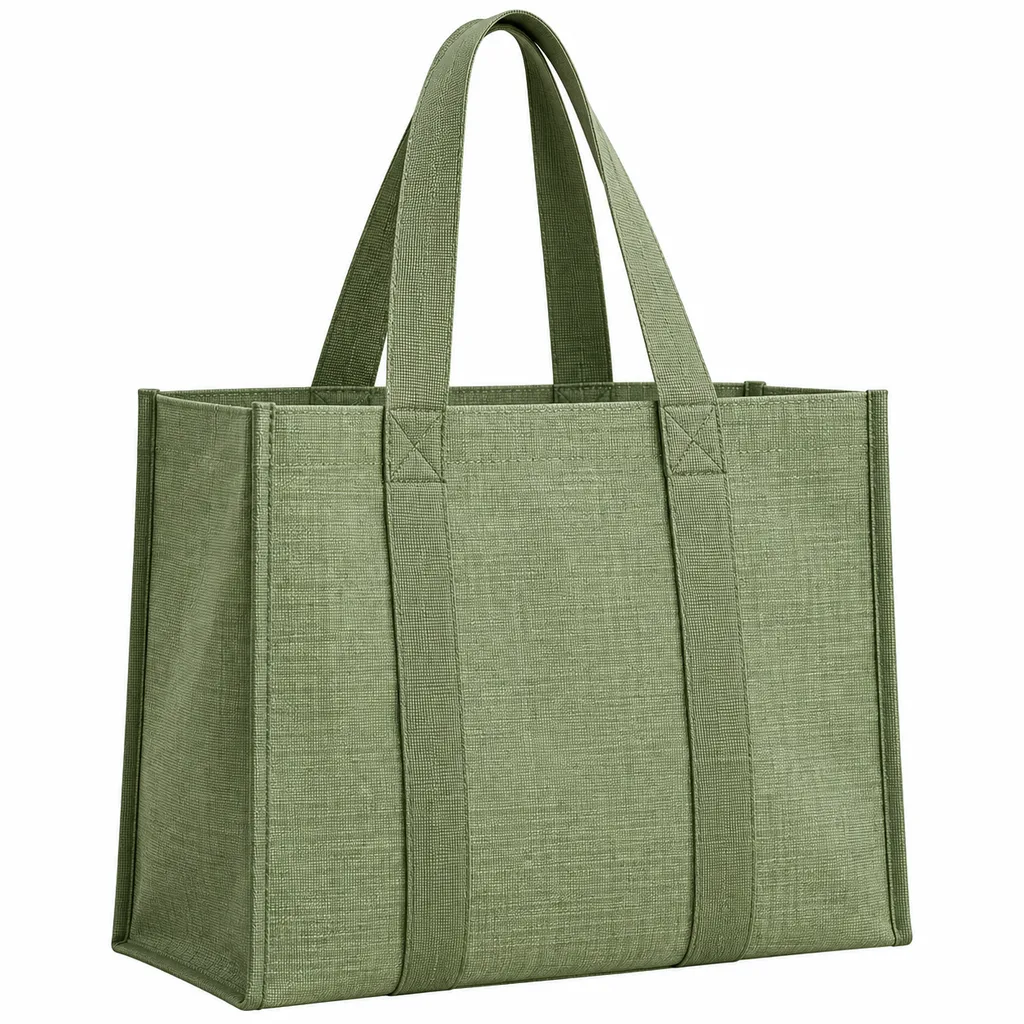
Most rPET enquiries we get start the same way. Someone in an ESG or HR team has been told the next gifting order has to be "made from recycled bottles", there is a sustainability report due, and nobody in the room knows what an rPET bag should cost, what fabric weight to ask for, or how to check that the supplier is not simply selling ordinary polyester with a green tag stitched on.
That last worry is fair. Once dyed and stitched, recycled and virgin polyester feel almost identical, and plenty of "eco" stock in the wholesale markets has no paperwork behind it.
We make rPET bags at our Mumbai bag factory alongside our polyester, canvas and non-woven lines, so we see both sides: what the fabric mills actually supply, and what buyers expect when they say "recycled". This guide covers fabric grades, sizes, rupee price bands, printing, certification, lead times and the questions to ask before you pay an advance.
What rPET actually is, in plain terms
rPET stands for recycled polyethylene terephthalate. PET is the plastic used in water and soft drink bottles. Collected bottles are sorted, washed, shredded into flakes, melted and extruded into fibre, and that fibre is spun into yarn and woven or bonded into fabric. Chemically it is still polyester. The difference is where the raw material came from.
On our cutting floor, rPET behaves like the virgin polyester we have cut for decades. The practical differences are availability and price: fewer mills stock it in every colour, and recycled yarn costs more.
You will see two broad families of rPET bag material. Woven rPET is the one most corporate buyers mean, a proper fabric measured in denier (210D, 300D, 600D). rPET non-woven is a spunbond sheet like the one used in standard non-woven bags, but made from recycled PET instead of polypropylene. It is cheaper, lighter and less durable.
The table below shows the fabric grades we work with most and where each one makes sense.
| Fabric grade | Feel and weight | Typical bag types | Our honest take |
|---|---|---|---|
| rPET non-woven, 70 to 100 GSM | Light, papery, slightly stiff | Retail carry bags, one-time event giveaways | Cheapest route to a recycled claim, but it looks like any non-woven bag |
| 210D woven rPET | Thin, soft, folds very small | Drawstring bags, foldable shoppers, pouches | Good for drawstrings, too floppy for a structured tote |
| 300D woven rPET | Medium body, smooth face | Tote bags, conference bags, shopping bags | The workhorse grade, around 70 percent of our rPET orders |
| 600D woven rPET | Heavy, canvas-like, holds shape | Premium totes, backpacks, laptop sleeves, cooler bags | Worth it for gifting kits people will actually keep |
| 600D rPET with PU or PVC coating | Heavier, water resistant back | Backpacks, duffels, utility bags | Coating adds weight and cost, only take it if the bag will see rain |
Denier is a measure of yarn thickness, not fabric weight. Two 300D fabrics from different mills can differ in weave density and feel. When you compare quotes, ask each supplier for the GSM of the fabric as well as the denier, and ask for a swatch.
Who orders rPET bags, and what they usually pick
The buyer decides the spec more than the material does. A brand launching a sustainability campaign and a hospital printing patient discharge bags both want "recycled", but their budgets and quality bars are very far apart.
Here is how the orders usually break down across the buyers we deal with.
| Buyer | Typical order | Usual spec | What they care about most |
|---|---|---|---|
| Corporate ESG and HR teams | 300 to 3,000 pieces | 300D or 600D tote, one or two colour logo | Paperwork for the sustainability report, a bag employees keep |
| Conference and event organisers | 500 to 5,000 pieces | 300D tote or sling with sponsor logos | Deadline, sponsor print accuracy, per piece cost |
| Retail and fashion brands | 1,000 to 20,000 pieces | rPET non-woven or 300D shopper | Unit price, brand colour match, carry strength |
| Exporters and private label sellers | 1,000 pieces and up | 300D or 600D with care labels and inner pocket | Recycled content claims that hold up abroad, consistent repeat orders |
| Gyms, clubs and schools | 200 to 2,000 pieces | 210D drawstring or 600D duffel | Durability and a low per piece rate |
For kits, see our employee welcome kits and corporate gifting pages. A pairing we pack often is a 600D rPET tote, a steel bottle and a recycled paper notebook.
rPET bag prices in India: realistic rupee bands
Everyone wants a number first, so here it is. These are rough bands for a plain bag with a one colour screen print on one side, ex-factory Mumbai, before GST and freight. Prices move with fabric rates, which follow bottle flake prices, so treat these as a guide for budgeting and get a written quote for your exact spec.
| Bag type and size | 500 pieces | 1,000 pieces | 5,000 pieces |
|---|---|---|---|
| rPET non-woven loop handle, 12 x 15 in | Rs 28 to Rs 42 | Rs 24 to Rs 36 | Rs 20 to Rs 30 |
| 210D rPET drawstring, 14 x 18 in | Rs 55 to Rs 80 | Rs 48 to Rs 70 | Rs 40 to Rs 60 |
| 300D rPET tote, 15 x 16 in, no gusset | Rs 85 to Rs 130 | Rs 75 to Rs 115 | Rs 65 to Rs 100 |
| 300D rPET tote, 14 x 16 x 4 in gusset, inner pocket | Rs 120 to Rs 170 | Rs 105 to Rs 150 | Rs 95 to Rs 135 |
| 600D rPET premium tote with zip and lining | Rs 210 to Rs 320 | Rs 190 to Rs 290 | Rs 170 to Rs 260 |
| 600D rPET laptop backpack | Rs 650 to Rs 1,100 | Rs 600 to Rs 1,000 | Rs 550 to Rs 900 |
As a rule of thumb, the same bag in rPET costs us roughly 10 to 25 percent more than in virgin polyester, depending on the colour and how much fabric the mill has in stock. Anyone quoting rPET at the same price as plain polyester should be asked, politely, where the fabric certificate is. For full price lists across our other materials, see our bulk pricing page.
What pushes the price up or down
The table below lists the factors that move an rPET quote the most, roughly in order of impact.
| Factor | Effect on price | Where to save |
|---|---|---|
| Fabric grade (210D, 300D, 600D) | 600D can be close to double 300D per metre | Use 300D for event totes that get light use |
| Recycled content paperwork (GRS lot) | Adds roughly 5 to 15 percent | Only pay for it if you will publish the claim |
| Custom colour dye lot | Mill minimums of 1,000 to 2,000 metres | Pick from stock shades like black, navy, grey, olive |
| Print colours and sides | Each extra screen colour adds Rs 3 to Rs 8 a piece | One colour on one side often looks cleaner anyway |
| Gusset, lining, zip, pockets | Each feature adds stitching time and fabric | Drop the lining on totes under 15 inches |
| Handle type | Webbing handles cost more than self-fabric | Self-fabric handles in 300D are strong enough for 6 to 8 kg |
| Quantity | Setup is spread over more pieces | Combining two events into one order helps |
Sizes that work, and the ones that waste money
There is no "standard tote", but some sizes fit what people actually carry. An A4 folder needs at least 13 inches of width, and a laptop needs a gusset or sleeve.
These are the sizes we cut most often in rPET and what they hold.
| Size (W x H x gusset) | Fits | Best fabric | Use case |
|---|---|---|---|
| 12 x 14 in, flat | A5 notebook, small gifts | rPET non-woven or 210D | Retail counter bag, sample bag |
| 14 x 18 in drawstring | Gym clothes, shoes, kit items | 210D | Clubs, schools, marathons |
| 15 x 16 in, flat | A4 folder, diary, bottle | 300D | Conferences, training programmes |
| 14 x 16 x 4 in | A4 files plus a lunch box | 300D or 600D | Employee tote, daily office use |
| 16 x 14 x 5 in with zip | 13 to 14 inch laptop in a sleeve | 600D | Premium gifting, leadership kits |
| 18 x 15 x 6 in | Groceries, bulky retail purchases | 300D with webbing handles | Supermarkets, lifestyle stores |
One mistake we see often: buyers choose a flat 13 x 13 inch bag because it looked good in a mock-up, then find the A4 welcome folder will not go in without bending. Measure the largest item that goes in the bag and add at least an inch on each side. If you are still choosing between bag styles, our guide to custom drawstring bags covers that format in detail.
Printing on rPET: what holds up and what fades
Woven rPET has a smooth, slightly shiny face, so it prints sharper than jute or loose canvas. Fine text down to about 8 point comes out clean with a good screen. The non-woven version is more porous and soaks up ink, so we keep text a little bigger on those.
Here is how the main print methods compare on rPET fabric.
| Print method | Best for | Approximate added cost per piece | Durability on rPET |
|---|---|---|---|
| Screen print (plastisol or water-based) | Logos in 1 to 4 solid colours | Rs 4 to Rs 10 per colour per side | Very good, survives 30+ washes |
| Heat transfer vinyl | Small runs, names, numbering | Rs 12 to Rs 30 | Good, can lift at edges after heavy use |
| Digital heat transfer (DTF) | Photos, gradients, many colours | Rs 18 to Rs 45 | Good on 300D and 600D |
| Sublimation | All-over prints on white or light rPET | Rs 25 to Rs 60 | Excellent, ink goes into the fibre |
| Embroidery | Premium logos on 600D | Rs 20 to Rs 70 depending on stitch count | Excellent, avoid on 210D as it puckers |
Because rPET is polyester, sublimation dyes bond with it properly, which cotton and jute cannot manage. It only works on white or very light fabric, though. If you need help choosing, our pages on screen printed bags and logo printed bags show real samples.
Many buyers also add a small line like "Made from recycled PET bottles" near the logo. Only print it if your fabric lot has the paperwork to back it. We cover that next.
Certification: how to know the fabric is really recycled
This is the section most supplier pages skip, and it is the one your sustainability team will ask about. There is no visual test for recycled polyester. The proof is in the paperwork chain from the recycler to the fabric mill to the bag maker.
The most widely used scheme for textiles is the Global Recycled Standard (GRS), run by Textile Exchange and audited by third-party certification bodies. Two numbers matter. According to SCS Global Services, one of the certifiers, a product needs at least 50 percent certified recycled content to carry the GRS label, and products with 20 percent up to under 50 percent can be certified without using the label. A related standard, the Recycled Claim Standard (RCS), also exists for recycled content claims.
In practice, when you buy GRS paperwork for a bag order, you are paying for a transaction certificate that traces your specific lot. Here is what to ask a supplier for, depending on how you plan to use the claim.
| How you will use the claim | What to ask for | Is it worth the extra cost |
|---|---|---|
| Internal gifting, no public claim | Mill's fabric specification sheet stating recycled content | No certificate needed |
| Company sustainability or ESG report | Fabric scope certificate copy and invoice trail | Usually yes, auditors may ask |
| Printing "recycled" on the bag or packaging | Transaction certificate for your lot | Yes, the claim is public |
| Export to EU, UK or US retail | Transaction certificate plus buyer's own compliance check | Yes, retailers increasingly ask for it |
We will tell you at the quote stage whether the fabric lot for your order comes with certification paperwork. Not every rPET fabric in the Indian market does, and certified lots cost more and sometimes take longer to arrive. If a supplier says "yes, it's certified" but cannot send a certificate number you can check, treat the claim as unverified.
A word on bottle counts. You will see bags advertised as "made from 7 bottles" or similar. The number depends on bottle weight and the fabric weight of your bag, so it changes from order to order. As rough arithmetic, a 300D tote that uses 80 to 100 grams of fabric, made from bottles weighing 15 to 25 grams each, works out to somewhere between 3 and 7 bottles. Do not print a bottle number unless the mill gives you one in writing for that fabric.
rPET compared with cotton, jute, canvas and non-woven
Buyers often come to us undecided between rPET and a natural fibre. There is no single right answer. Each material has a different sustainability story and a different feel in the hand.
The comparison below is based on what we see across orders, not lab data.
| Material | Sustainability story | Water resistance | Print sharpness | Rough tote price at 1,000 pcs |
|---|---|---|---|---|
| Woven rPET 300D | Made from waste plastic bottles | Good, better with coating | Very sharp | Rs 75 to Rs 115 |
| Cotton 140 to 180 GSM | Natural fibre, biodegradable | Poor | Good | Rs 55 to Rs 95 |
| Canvas 10 to 12 oz | Natural, very long life | Fair | Good | Rs 110 to Rs 180 |
| Jute, laminated | Natural, India-grown | Good inside due to lamination | Fair, coarse texture | Rs 70 to Rs 130 |
| Non-woven PP 80 to 100 GSM | Reusable, recyclable in theory | Fair | Good | Rs 18 to Rs 35 |
Our view: pick rPET when the recycled-plastic message matters to your audience, when the bag might get wet (gym bags, cooler bags, travel kits), or when you want sharp full-colour print. Pick cotton bags or a canvas tote when you want a natural fibre story and a softer hand. Jute bags work well for Indian craft and festive themes. We wrote a longer side-by-side in non-woven vs jute vs canvas bags, and our eco-friendly bags buyer's guide covers the wider choice.
What Indian plastic rules mean for rPET bags
Some buyers worry that because rPET is a plastic, it falls under the carry bag ban. The Plastic Waste Management (Amendment) Rules, 2021 set a minimum thickness of 120 microns for plastic carry bags from 31 December 2022, and a minimum of 60 GSM for non-woven plastic carry bags from 30 September 2021. A stitched 300D woven rPET tote is far heavier than either threshold, and rPET non-woven bags should be made at 60 GSM or above. If you are handing bags out at a retail checkout, check the current rules with your state pollution control board, since states can add their own restrictions. Our post on non-woven bag GSM rules covers the non-woven side in more detail.
MOQ and lead times for rPET orders
Our standard minimum for rPET bags is 100 pieces in a stock fabric colour. Below that, the setup cost of screens and cutting patterns makes the per piece price awkward. For custom dyed colours, the fabric mill sets the minimum, not us, and it usually runs to 1,000 metres or more. Our minimum order quantity page explains MOQs across all our bag types.
Lead time depends mainly on whether the fabric is in stock. The table below assumes sample approval is done and artwork is final.
| Order size | Stock colour rPET | Custom dyed rPET | With certification paperwork |
|---|---|---|---|
| 100 to 500 pieces | 10 to 15 working days | Not usually practical | Add 5 to 10 days |
| 500 to 2,000 pieces | 15 to 20 working days | 25 to 35 working days | Add 5 to 10 days |
| 2,000 to 10,000 pieces | 20 to 30 working days | 30 to 45 working days | Add 7 to 15 days |
| Export orders, any size | Production time plus 3 to 5 days for packing and documents | Same | Same |
The usual delay is waiting for fabric, not stitching. Last spring a conference client wanted navy 300D rPET that was out of stock at the mill for three weeks; switching to grey saved their date. Confirm fabric before you finalise artwork.
Checks to run before you approve and when bags arrive
rPET bags fail in the same places as any polyester bag: handles, seams, and print. A careful buyer can catch nearly every problem in ten minutes with a sample. Our quality control process follows these same steps on the production floor.
- Load the sample tote with 6 to 8 kg (a few water bottles and books) and hold it by the handles for a minute. Look at the handle joint for stretched stitching.
- Check that handle stitching uses a box or X pattern, not just a single straight line.
- Scratch the print with a fingernail. Screen print should not flake. Vinyl edges should not lift.
- Turn the bag inside out and look at the raw edges. Cut edges on woven rPET should be overlocked or bound, otherwise they fray after a few uses.
- Match the fabric colour against your brand Pantone in daylight, not under tube lights.
- Ask for the fabric spec sheet and, if you are paying for it, the certificate details before final payment.
- On delivery, open three or four cartons at random and count, rather than checking only the top carton.
We do a 100 percent visual check before packing, but your own five-carton check on delivery is a good habit with any supplier.
Exporting rPET bags from India
A fair share of our rPET work goes abroad, mostly for European and UK brands that need recycled content for retail compliance, and for US private label sellers. Overseas buyers usually ask for three things we do not see in domestic orders: a transaction certificate for the fabric lot, a sewn-in care label with fibre content, and carton markings that match their warehouse system.
If you are sourcing from abroad, our pages for bag buyers in Europe and private label bags cover packing, documentation and shipping. Sea freight to Europe or the UK adds roughly 25 to 35 days door to door after dispatch, so plan seasonal orders early.
How to order rPET bags from us
The process is simple, and most orders go from first message to dispatch in three to five weeks.
- Send us the quantity, bag type and size, print details, delivery city and your deadline on WhatsApp or through the contact form. Mention if you need certification paperwork.
- We reply within a day with fabric options in stock, a price band and a realistic date.
- You approve a digital mock-up of your logo on the bag.
- We make a physical sample (usually 3 to 5 working days). For repeat buyers we can skip this step.
- You confirm the sample and pay the advance. We start cutting.
- Bags are printed, stitched, checked, packed in cartons of 50 or 100 and dispatched by road, air or sea.
If your order includes other items, such as recycled notebooks, steel bottles or conference tote bags in a second material, put it all in one enquiry. A single delivery is easier to plan around an event date than three separate suppliers. You can also browse our full recycled PET bags and recycled bags range before you write.
Frequently asked questions
What are rPET bags made from?
They are made from recycled PET, the plastic used in drinks bottles. The bottles are washed, flaked, melted, spun into polyester yarn and woven into fabric. The finished bag looks and behaves like a polyester bag.
Are rPET bags more expensive than polyester bags?
Yes, usually by about 10 to 25 percent for the same size and print, because recycled yarn costs more and fewer mills stock it in every colour. Certified lots add a little more on top.
What is the minimum order for custom rPET bags?
Our standard minimum is 100 pieces in a stock fabric colour. Custom dyed colours depend on the mill's dye lot minimum, which is usually 1,000 metres or more of fabric.
Can you supply GRS certified rPET bags?
We can source certified fabric lots for orders that need them and will tell you at the quote stage whether paperwork is available for your colour and quantity. Certified lots cost more and can add a week or two to the lead time.
How long do rPET bags last?
A well-stitched 300D or 600D rPET tote used daily lasts years, much like a polyester tote. rPET non-woven bags are lighter and are better treated as short to medium term carry bags.
Can rPET bags be washed?
Yes. Hand wash or a gentle machine cycle in cold water, then air dry. Avoid ironing directly on screen print or vinyl. Uncoated rPET dries quickly, which is one reason gyms like it.
If you have a quantity and a date in mind, send us the details and we will come back with fabric options, a price band and a realistic delivery date within a working day. Use our enquiry form or message us on WhatsApp at +91 86525 70502, and tell us if you need certification paperwork so we can check the fabric lot before quoting.