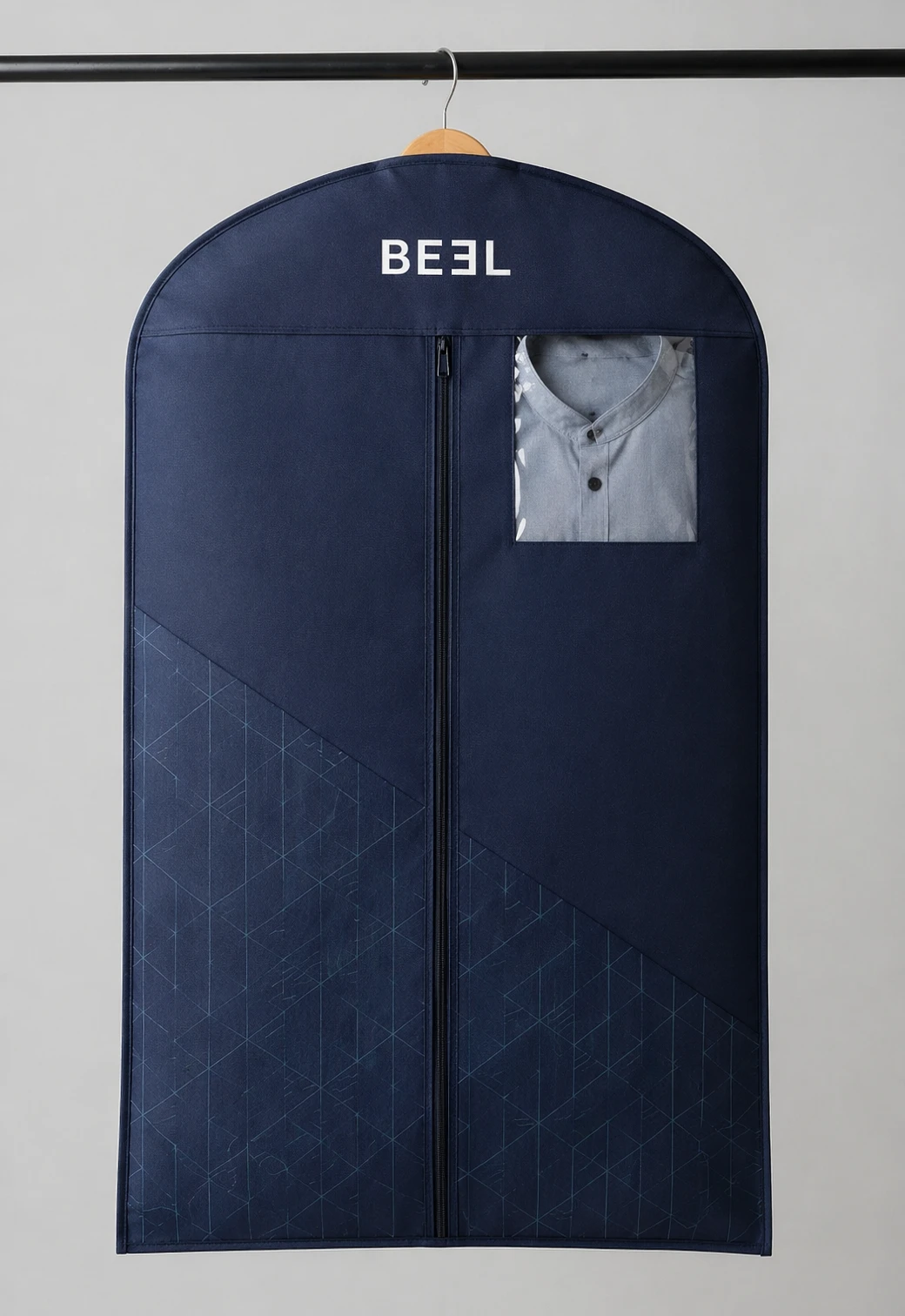
A tailor in Dadar once told us he lost a regular client over a cover. The suit itself was perfect. But it went home in a thin, unbranded plastic sleeve that tore at the hanger hook before the customer reached his car, and the jacket shoulder got a crease that took a steam press to fix. The client never said anything. He just stopped coming.
That is the real job of suit cover bags. They protect a garment someone paid ₹8,000 or ₹80,000 for, they carry your shop name into the customer's wardrobe for the next five years, and they decide whether the handover feels like a menswear store or a laundry counter. Most buyers who call us already know this. What they don't know is which fabric weight to choose, what length works for a sherwani, what a fair price is at 500 pieces, and how long printing really takes.
We have been cutting and stitching garment covers at our Mumbai bag factory since 1996, mostly for tailors, menswear retailers, wedding designers, dry cleaners and uniform suppliers. This guide puts down the answers we give on the phone every week, with sizes, GSM, price bands and the mistakes we see first-time buyers make.
Who actually buys suit covers in bulk
The buyer decides the spec more than the garment does. A dry cleaner and a wedding couturier both pack suits, but they need very different covers, and quoting them the same thing is how suppliers lose orders.
| Buyer | Typical order and what they need |
|---|---|
| Bespoke tailors and alteration shops | Usually 500 to 2,000 pieces a year, one or two colours, shop name and phone number printed. Price matters, but so does a cover that does not look cheap at delivery. |
| Menswear retail stores and chains | Larger runs, often 3,000 to 10,000 pieces, with a fixed brand colour and sometimes separate sizes for blazers, two-piece suits and three-piece suits. |
| Wedding and ethnic wear designers | Longer covers for sherwanis, achkans and bandhgalas, heavier fabric, sometimes a gusset for embroidered pieces. The cover goes into the wedding photographs, so finish matters. |
| Dry cleaners and laundries | They want a lighter, cheaper cover that still carries their name, because a customer who keeps the cover keeps the phone number. |
| Corporate uniform suppliers | Blazers for hotel staff, airline crew or school teachers, packed in hundreds, often with a size or employee label printed on the panel. |
If you sell blazers on their own, look at our slimmer blazer covers, which use less fabric and cost a few rupees less. For long overcoats and winter wear, the coat cover line is cut narrower and longer. Everything else on this page is about full suits and sherwanis.
Material choices: non-woven, PEVA, canvas and cotton
Most of the suit covers we make are polypropylene non-woven with a clear PVC window. That is not because it is the only option. It is because non-woven breathes, takes screen printing well, comes in dozens of shades, and keeps the price under ₹60 a piece for most orders. It is the same base fabric we use across our non-woven bags range, just cut and stitched differently.
PEVA (a plastic film, usually frosted or clear) is fully waterproof and looks clean on a rack. The trouble is that it does not breathe. In Mumbai's monsoon, a wool suit sealed in PEVA for three months can come out smelling musty, and we have seen mild mildew on linen blends. We still make PEVA covers for dry cleaners and for short dispatch use, but we tell wardrobe-storage buyers to avoid it.
Canvas and cotton covers sit at the top end. They breathe best, feel premium, and some designer labels want them because the customer reuses the cover for years. The catch is price (often three to five times a non-woven cover), weight, and the fact that cotton creases in storage. They work for a couture label shipping 300 sherwanis a season. They make no sense for a tailor delivering 150 suits a month.
| Material | Breathability | Water resistance | Typical price at 500 pcs | Best for |
|---|---|---|---|---|
| Non-woven 70 to 80 GSM with PVC window | Good | Light splash only | ₹25 to ₹40 | Tailors, dry cleaners, everyday retail |
| Non-woven 90 to 120 GSM, gusseted | Good | Light splash only | ₹40 to ₹60 | Menswear stores, sherwanis, wedding wear |
| Heavy matte non-woven, premium finish | Good | Light splash only | ₹60 to ₹120 | Designer labels, luxury retail |
| PEVA frosted or clear | Poor | High | ₹30 to ₹55 | Dry cleaners, short-term transport |
| Cotton or canvas | Very good | Low | ₹120 to ₹250 | Couture, gifting, long-term storage |
These are indicative bands for a single-colour print on a standard size. Multi-colour printing, custom shades, extra pockets and branded zip pulls push the number up. Our luxury garment covers page shows what the premium matte line looks like if you are deciding between the last three rows.
GSM: the number that decides how the cover feels
GSM is grams per square metre of fabric. For non-woven, it is the quickest way to tell a cover that feels flimsy from one that feels like part of the product. Buyers often ask for "the thick one" without a number, and then two suppliers quote 60 GSM and 100 GSM for the same enquiry. Always put the GSM in writing.
| GSM | How it feels | Where we recommend it |
|---|---|---|
| 60 to 70 | Light, slightly see-through against light, soft | Dry cleaners, single-use delivery covers, uniform dispatch |
| 75 to 90 | Opaque, holds shape on a hanger, prints sharply | Most tailors and menswear stores, our standard suit cover |
| 100 to 120 | Firm, almost card-like at the shoulder, feels premium | Sherwanis, three-piece suits, wedding collections |
| 120 and above | Stiff, heavy, usually matte laminated or double layered | Designer labels, display covers, export boutique orders |
On the legal side, India's Plastic Waste Management (Amendment) Rules, 2021 set a minimum of 60 GSM for non-woven plastic carry bags from 30 September 2021. Garment covers are a different product from carry bags, but we keep all our suit covers at 60 GSM or above anyway, so a retailer never has to argue the point with an inspector. If you want the detail on that rule, our non-woven GSM compliance guide goes through it.
One floor tip: hold the fabric sample up to a tube light. If you can read the print on the other side of a 70 GSM sheet, it will look cheap on your rack, even if it is technically strong enough.
Sizes that fit suits, sherwanis and three-piece sets
Length is where most first orders go wrong. A buyer measures a jacket, orders covers to that length, and then finds the trousers hanging below the zip. The cover has to fit the garment on its hanger, including the hook and the trouser fold.
| Garment | Cover width | Cover length | Gusset |
|---|---|---|---|
| Blazer or single jacket | 58 to 60 cm (about 23 to 24 in) | 95 to 105 cm | None or 5 cm |
| Two-piece suit on one hanger | 60 cm (24 in) | 130 cm (about 51 in), our standard | None or 5 cm |
| Three-piece suit or heavy wool suit | 60 to 62 cm | 130 to 135 cm | 8 to 10 cm |
| Sherwani, achkan, bandhgala with churidar | 60 to 62 cm | 150 cm (about 59 in), our extended size | 8 to 12 cm for embroidered pieces |
| Indo-western with dupatta or long overcoat | 62 cm | 160 to 180 cm | 10 cm |
The gusset is the side panel that gives the cover depth. Flat covers are fine for a single suit. A heavily worked sherwani, though, has zardozi or stone work that gets crushed in a flat cover, and the extra 10 cm of depth is worth the ₹5 to ₹8 it adds per piece. Our suit and sherwani covers come in both the 130 cm and 150 cm lengths, and mixed orders count toward the same minimum.
Also decide on the hanger opening early. A plain slit at the top fits any hanger. A reinforced hole with a binding edge looks neater but must match the hooks you use. Wooden hangers with thick hooks have torn more than one batch of covers that were made for wire hangers.
Features worth paying for, and a few that are not
Every extra feature costs a few rupees. On 2,000 covers, ₹4 a piece is ₹8,000, which is real money for a tailoring shop. Here is how we would spend it.
Worth it for most buyers
- A clear PVC window: Staff can see which suit is inside without unzipping. In a shop with 80 finished orders on a rail before Diwali or wedding season, this saves real time and stops wrong handovers.
- A full-length zip with a decent slider: We use a nylon coil zip. Cheap sliders jam after a few uses, and a customer who struggles with the zip blames the shop, not the cover maker.
- Double stitching at the hanger opening: This is where covers fail. The weight of a wool suit sits on 3 to 4 cm of fabric at the top.
- A gusset for sherwanis: Mentioned above, and the one upgrade that wedding designers almost never regret.
Nice, but think twice
- Accessory pocket: Useful for a tie or pocket square in wedding orders. Pointless for a dry cleaner.
- Branded zip pull: Looks smart, adds cost and a week of lead time if the pulls are custom moulded.
- Carry handles: Good if customers walk out with the cover over their arm. Most tailors deliver on the hanger, so the handles are rarely used.
- Four-colour printing: A single-colour logo in white or gold on a navy, black or tan cover looks better than a busy full-colour print most of the time.
Printing your logo: what works on non-woven
Screen printing is the standard for suit covers. It is cheap per piece once the screen is made, the ink sits well on non-woven, and white or gold on a dark cover looks clean. We cover the process in more depth on our screen printed bags page, but the short version is one screen per colour, one or two days of setup, and a print area on the front panel of roughly 25 x 30 cm.
What to print is a bigger question than how. Tailors usually want shop name, logo, phone number and address. That is fine, but keep it to three lines. A front panel with seven lines of text looks like a pamphlet. One menswear client moved their address to a small line near the bottom and made the logo three times bigger, and the covers started showing up in their customers' Instagram wedding posts. Nobody posts a phone number.
Heat transfer and digital prints are possible for photographic artwork or very small runs, but they cost more per piece and can crack on non-woven over time. For runs below 500, those methods sometimes make sense. Above that, screen printing wins on both cost and durability. Our general guide to logo printed bags explains the trade-offs across different fabrics if you are ordering other bags at the same time.
Colour matching: non-woven is dyed in the fibre, so shades come from the mill's range. We hold navy blue, black and tan as standard, and can source most Pantone-close shades for orders of around 2,000 pieces or more. Below that, pick the nearest stock colour. Asking for an exact brand maroon on 500 covers usually means a longer wait and a higher price for a difference only your designer will notice.
Suit cover bags wholesale price: what decides the number
At our MOQ of 500 pieces, a standard non-woven suit cover with a PVC window, zip and single-colour print usually lands between ₹25 and ₹60 a piece. That range is wide on purpose, because five things move the price:
| Price factor | Effect on price |
|---|---|
| Size | A 150 cm sherwani cover uses roughly 15 to 20 percent more fabric than a 130 cm suit cover. |
| GSM | Going from 75 to 100 GSM adds a few rupees a piece, more on gusseted covers. |
| Gusset and pockets | Each adds cutting and stitching time. |
| Print colours | Each extra colour needs a new screen and another pass. |
| Quantity | The per-piece rate drops noticeably between 500 and 2,000 pieces, and again past 5,000, because setup costs get spread out. |
Prices quoted on B2B directories can look lower, sometimes ₹15 or ₹18 a piece. Check what they are quoting. Often it is 50 GSM, no window, no zip, a velcro strip at the bottom and no print. That is a dust sleeve, not a suit cover you hand to a paying customer. For a full breakdown of how we price across products and quantities, see our bulk pricing page, and the minimum order quantity page explains why 500 is the floor for most printed covers.
If 500 is too many for a small boutique, our boutique garment covers start at 300 pieces with the same construction. The per-piece rate is a little higher, but the total bill is smaller and you are not storing four years of covers in the back room.
GST on non-woven covers and freight outside Mumbai are quoted separately, so compare landed cost, not the headline rate. A cheaper quote from a supplier 1,500 km away can cost more once a part load of bulky cartons is shipped to your door.
Lead times and planning around wedding season
Our standard lead time is 7 to 12 working days after you approve the artwork and sample. Here is how that usually breaks down on our floor:
| Days | Production stage |
|---|---|
| Day 1 to 2 | Fabric cut to size, screens made |
| Day 2 to 4 | Printing and drying on the flat panels |
| Day 4 to 9 | Stitching, window fixing, zip attachment |
| Day 9 to 12 | Checking, folding in bundles of 50, cartoning and dispatch |
Custom colours add roughly a week for fabric procurement. Premium finishes and heavier covers take 10 to 15 working days. Road transit within Maharashtra is one to three days. Delhi, Kolkata or Chennai take four to seven days by surface transport.
The planning mistake we see every year is ordering covers in the same week as the wedding rush begins. From October to February, tailors and ethnic wear designers all order at once, and our stitching line runs full. Buyers who place their order in August or September get faster turnaround and more time to approve the sample properly. If you are also planning return gifts or wedding packaging, our wedding return gift bags guide has a timeline that works for both.
Checking quality before you accept a delivery
We run our own checks (the full list is on our quality control page), but every buyer should still open a few cartons when the order arrives. It takes 15 minutes and saves arguments later.
- Measure three covers from different cartons. Length and width should be within 1 to 1.5 cm of the approved sample.
- Run every zip on those three covers end to end. It should not catch at the corners or the bottom curve.
- Pull at the hanger opening. The stitching should not open up when you tug with moderate force.
- Look at the print in daylight. Check for smudges, broken letters and registration shift on two-colour prints.
- Check the PVC window seam. It should be stitched flat, without puckering, and should not crack when you fold it.
- Hang a real suit in one. This is the test that matters. The shoulder should sit inside the cover without stretching the fabric.
If something is off, photograph it with the carton number and tell your supplier within a few days. A good manufacturer will replace defective pieces. Waiting three months makes that conversation much harder.
Pairing suit covers with the rest of your packaging
Many menswear and wedding clients order suit covers together with other covers, and it saves money because cutting, printing and freight get shared. A designer who makes sherwanis usually also packs lehengas, sarees and bridal gowns. Ordering the lehenga cover, saree cover and wedding dress cover in the same colour and print as your suit covers gives the whole store one look.
Some tailors also add a small shoe or accessory bag for wedding orders. A cotton or non-woven drawstring pouch printed in the same colour works well, and our guide to custom drawstring bags covers sizes for shoes and accessories. Retail clients often order carry bags alongside, which our bags for retail stores page covers.
Saree buyers have their own questions about window size, fold size and silk storage, which we answered in our saree cover manufacturer guide and the saree cover wholesale market guide. The full set of covers we make is on our suit and saree covers page.
We ship across India from Mumbai, and a fair share of our cover orders go to Delhi and Gujarat. If you are in the north, our bag manufacturer in Delhi page explains delivery times and freight. Export buyers in the Gulf ordering covers along with garments can read our bag supplier for UAE page for shipping and documents.
How to order suit covers from us
The process is simple, and most orders go from first message to dispatch in two to three weeks.
- Step 1: Send the basics. Quantity, garment type (suit, sherwani, blazer or mixed), preferred colour, logo file and the date you need the covers. WhatsApp on +91 86525 70502 or the form on our contact page both work.
- Step 2: Get a quote and a fabric choice. We reply with a price for two or three GSM options and tell you honestly which one we would pick for your use.
- Step 3: Approve the artwork. We send a digital mock-up of the print on the cover. Check spelling and phone numbers twice. We have reprinted entire batches for one wrong digit, and it is never fun for anyone.
- Step 4: Approve a physical sample. For new clients we make one stitched sample with your print. Hang your own suit in it before you approve.
- Step 5: Production and dispatch. Once you approve and pay the advance, production starts. We share photos from the floor, pack in cartons of 100 or 200, and dispatch by your transporter or ours.
Frequently asked questions
What is the minimum order for printed suit covers?
500 pieces for a standard size with a single-colour print. Suit and sherwani lengths can be mixed within that 500. Boutique orders can start at 300 pieces with a slightly higher rate.
What size suit cover do I need for a sherwani?
Use the extended 150 cm length with a width of about 60 cm. For heavily embroidered sherwanis, add an 8 to 12 cm gusset so the work does not get pressed flat.
Is non-woven or PEVA better for suit covers?
Non-woven for storage and customer handover, because it breathes. PEVA only for short-term transport or dry cleaning, where water resistance matters more than airflow.
How much does a custom suit cover cost in bulk?
Roughly ₹25 to ₹60 a piece at 500 units for non-woven with a window, zip and one-colour print. Premium matte covers run ₹60 to ₹120, and cotton or canvas covers cost more.
How long does production take?
7 to 12 working days after artwork and sample approval for standard covers. Add about a week for custom colours, and plan earlier for October to February.
Can you print a different name or size on each cover?
We can print size labels or SKU codes on runs of the same design. Fully personalised names on each cover are possible on small batches using heat transfer, quoted separately.
Do you deliver outside Mumbai?
Yes, across India by surface transport and to the Gulf, UK and USA for export orders. Freight is quoted separately based on carton count and destination.
If you are a tailor, menswear store or wedding designer and want suit covers that match the quality of what goes inside them, send us your quantity, garment type and logo. We will reply with a price for two fabric options and a realistic delivery date. Message us on WhatsApp at +91 86525 70502 or use our contact form, and we will usually get back to you the same working day.