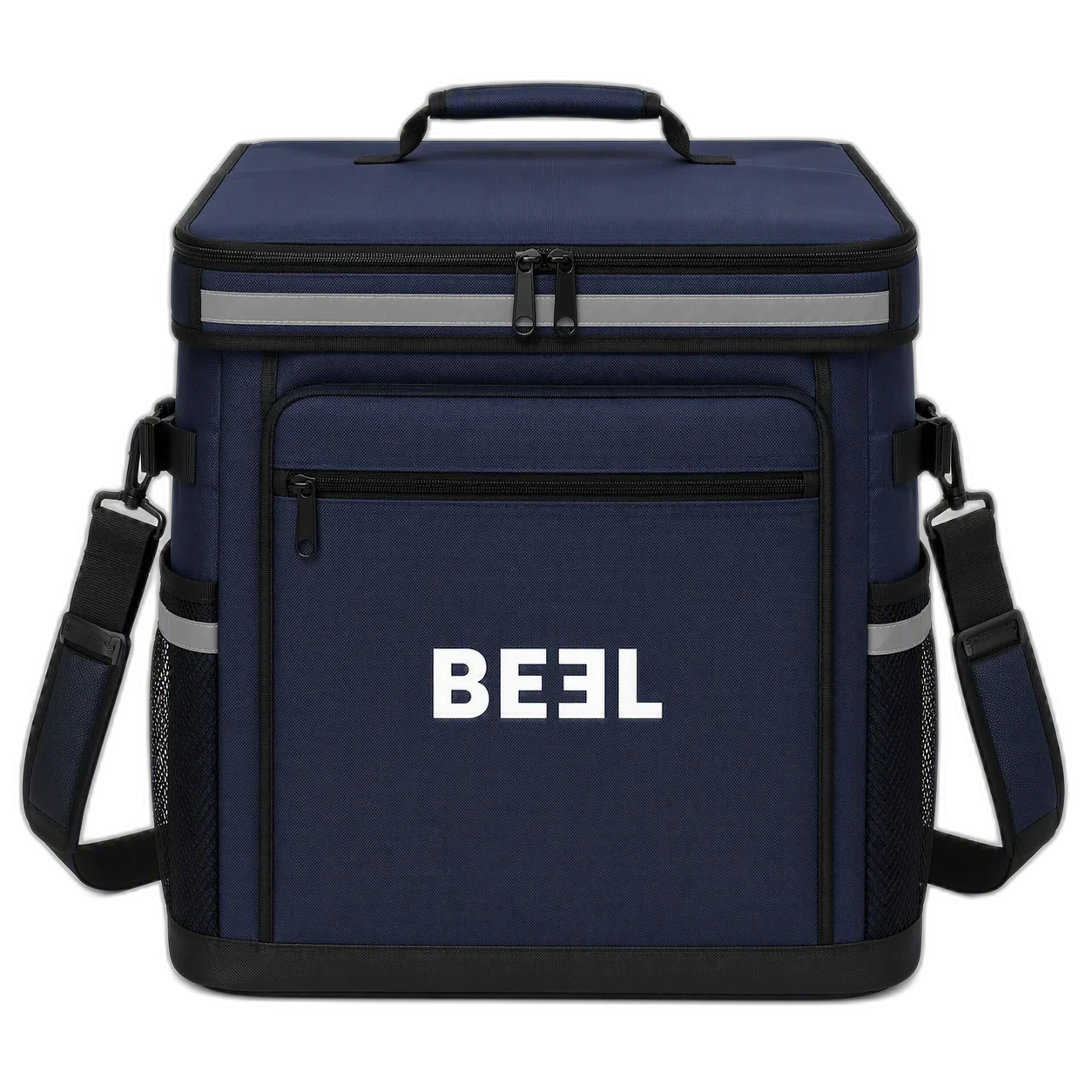
Buying in bulk? See our delivery bags, made at our Govandi, Mumbai factory with pan-India delivery.
The stretch of the Mumbai Metropolitan Region running through Panvel, Taloja and Uran has grown into one of India's busiest logistics and warehousing corridors, driven by proximity to Jawaharlal Nehru Port (JNPT), the industrial estates around Taloja, and the wider growth this area is seeing as the upcoming Navi Mumbai International Airport comes online nearby. Warehousing companies, third-party logistics operators, dark kitchens and food delivery fleets have all set up in real numbers here, and every one of them eventually needs bulk-branded bags, whether that is an insulated delivery bag for a rider, a cooler bag for a staff pantry, or a kit bag issued to warehouse floor staff.
This guide is for logistics operators, food delivery and dark-kitchen businesses, warehouse and industrial employers, and travel or tour operators based in Panvel, Taloja and Uran who need bulk bags and want to understand what is available, what it costs, and how quickly it can be delivered from a Mumbai factory that is a short drive away.
Why This Corridor Has Unusual Bag Demand
Most bag buyer guides are written for retail or corporate-office audiences. Panvel, Taloja and Uran are different: the dominant buyers here are logistics and warehousing companies, food delivery and cloud-kitchen operations serving the area's growing residential population, industrial employers who need practical, durable staff-issue bags rather than premium gifting items, and a smaller but real segment of travel and tourism operators who use Panvel as a gateway toward Matheran and other nearby destinations. That means the priorities are different too. Durability, insulation performance and fast reorder turnaround usually matter more here than finish quality or branding subtlety.
The area's growth trajectory also matters for anyone planning bag procurement over the next few years rather than just the next order. As the Navi Mumbai International Airport moves toward operational status and JNPT's throughput continues to grow, the logistics, warehousing and hospitality businesses serving this corridor are only likely to scale up, which means a supplier relationship that works well at your current order size should also be able to scale with you, rather than being a one-time factory-direct discovery.
Insulated Delivery Bags for Food and Quick-Commerce Fleets
Panvel and the surrounding residential growth corridor has brought a real increase in food delivery and quick-commerce operations, and insulated delivery bags are one of the most consistent bulk orders coming out of this belt. Our delivery bags range starts from ₹380 per piece for 50-plus units, and covers food delivery backpacks for restaurant and cloud-kitchen fleets, pizza delivery bags sized to standard pizza box dimensions, and grocery delivery bags, including a foldable option that collapses flat for rider storage between drops, which suits quick-commerce operations running high delivery volumes.
All of our delivery bags use EPE foam insulation with aluminium lining, which keeps food hot for two to four hours during transit, a genuinely important spec for a delivery fleet operating across Panvel's growing residential spread, where drop distances can run longer than in a dense urban core. Our Insulated Food Delivery and Pizza Bags buyer's guide covers insulation performance and durability comparisons in more depth if you are evaluating suppliers.
How Insulation Actually Performs, and What to Ask a Supplier
Not all "insulated" delivery bags perform the same, and it is worth understanding what is actually inside the bag before ordering a large batch. EPE foam, the material we use, is a closed-cell foam that resists compression better than cheaper open-cell alternatives, meaning it keeps its insulating thickness even after repeated folding and stacking inside a delivery box. The aluminium foil lining reflects heat back into the bag's interior rather than letting it escape through the fabric, which is the main reason a well-made bag holds temperature for hours rather than minutes. A thinner, cheaper bag might look similar from the outside but use a lower grade of foam that compresses permanently after a few weeks of daily use, at which point it stops insulating effectively even though it still looks like an insulated bag.
If you are comparing suppliers, it is reasonable to ask directly what foam thickness and grade is used, and to request a sample bag that you can test yourself by placing a hot item inside and checking the temperature after two hours, rather than relying purely on a supplier's marketing description.
Cooler Bags for Staff Pantries and Cold-Chain Handoffs
Warehousing and logistics operations around Taloja frequently need cooler bags for staff pantry use, and food and pharma-adjacent logistics operators sometimes need them for short cold-chain handoffs between a warehouse and a delivery vehicle. Our cooler and lunch bags range includes cooler tote bags and thermal bags, food-safe and suitable for corporate pantry or staff-welfare use, distinct from the heavier-duty delivery-fleet bags above. Our Insulated Cooler and Lunch Bags guide covers the FMCG and corporate gifting angle in more detail, which is a useful comparison if you are deciding between a staff-welfare cooler bag and a full delivery-grade insulated bag.
A distinction worth understanding upfront: a staff-welfare cooler bag, meant to keep an employee's lunch cool for a few hours in a pantry or locker, does not need the same insulation grade as a delivery-fleet bag that has to hold temperature through repeated door-opening across a full shift on the road. Ordering the heavier-duty specification for a staff pantry use case is usually an unnecessary cost, while ordering the lighter staff-welfare specification for an actual delivery fleet risks underperforming exactly when it matters most, mid-route on a hot day.
Utility and Kit Bags for Warehouse and Industrial Staff
Taloja's industrial estates and the warehousing operations spread across Panvel regularly need durable utility bags for staff, whether as a joining-kit item for new warehouse hires or as a standing uniform-and-kit issue for floor staff. Our utility bags range is built for exactly this kind of daily, functional use rather than corporate-gifting presentation, and can be combined with our employee welcome kit range if you want to pair a kit bag with a water bottle, notebook or other onboarding items for new warehouse or logistics hires.
For an operation running continuous hiring, as many warehousing and logistics businesses in this corridor do given seasonal volume spikes around festival shopping periods, a standing kit-bag order tied to your onboarding calendar tends to work out more cost-effectively than ordering in occasional, unpredictable batches whenever headcount happens to jump.
Travel and Trolley Bags for Tour Operators Near Matheran
Panvel's position as a gateway toward Matheran and other nearby hill-station and pilgrimage destinations means a smaller but genuine segment of local businesses are travel and tour operators rather than logistics companies. Our tours and travel bags range covers canvas duffles and backpacks suited to short getaway packages, and our trolley bags and luggage collection covers wheeled options for operators running longer multi-day packages. If your business also handles pilgrimage tour packages, our dedicated pilgrimage tour kits range is worth a look, and our Char Dham and Hindu Yatra Kit Bags guide covers that specific buyer segment in detail, even though it is written primarily for a different geography.
Export and Logistics Documentation Support Near JNPT
Because our factory already exports internationally, businesses in the Panvel-Uran belt working adjacent to JNPT sometimes ask whether we can support export-linked bag orders directly, rather than only supplying for domestic delivery and warehouse use. We do export from our Mumbai facility, and our exporter of bags from India page and international shipping and logistics page cover how that process works, including documentation and freight handling, which may be relevant if your business sits at the intersection of logistics and product sourcing rather than purely domestic delivery.
Reliable Reorders Matter More Than a One-Off Order Here
Unlike a corporate gifting order that happens once a year, logistics, delivery-fleet and warehouse bag demand in this corridor tends to be recurring: fleets grow, bags wear out and need replacing, and new hires need kit bags on a rolling basis. If your operation is likely to reorder every few months rather than placing a single bulk order, it is worth setting up a standing supply arrangement with your supplier rather than treating each order as a fresh negotiation. Our food delivery bags guide covers how a repeat-order supply agreement typically works, which is directly relevant for a fleet operator based in this corridor.
A Practical Example: Scaling a Delivery Fleet's Bag Order
To make this concrete, consider a hypothetical quick-commerce dark-store operator in Panvel starting with a fleet of 20 riders. An initial order might be 40 to 50 insulated delivery backpacks, allowing for spares and bags in wash or repair rotation, alongside a smaller batch of grocery delivery bags for a separate grocery-focused delivery line if the business runs both formats. As the fleet grows toward 50 or 100 riders over the following year, a standing reorder arrangement means each additional batch of bags can be produced against the same approved specification and artwork, without renegotiating pricing or waiting through a full new-supplier onboarding process each time headcount increases. This is the pattern we see most often among growing quick-commerce and food delivery operators in this corridor, and it is worth planning for from the first order rather than treating each fleet expansion as a fresh sourcing exercise.
Backpack Style Versus Box-Mounted Delivery Bags
Fleet operators in this corridor typically choose between two delivery formats, and the right choice depends on your vehicle setup and delivery pattern rather than personal preference. A backpack-style insulated bag keeps a rider's hands free at drop points and is easier to carry into apartment buildings and up stairs, which matters in the many mid-rise residential complexes spread across Panvel's newer developments. A box-style bag, mounted to the rear of a two-wheeler, holds a larger volume and is generally preferred for grocery and quick-commerce delivery where a single trip covers multiple stops and a higher item count than a single food order. Some fleets run both formats depending on the specific delivery type, using backpacks for food orders and box-mounted bags for grocery runs, rather than standardising on one style across the whole operation.
If you are unsure which format suits your operation, it is worth thinking through a typical delivery day rather than assuming one format is universally better. A fleet doing high-frequency, single-item food drops across dense residential buildings usually benefits more from the backpack format's manoeuvrability, while a fleet doing fewer, larger multi-item grocery drops usually benefits more from the box format's capacity.
Hygiene and Food-Safety Expectations for Delivery Bags
Food delivery bags carry a hygiene expectation that goes beyond simple durability, and this matters more in a corridor with as much cloud-kitchen and quick-commerce density as Panvel and the surrounding belt. A delivery bag's interior lining should be a food-safe material that can be wiped down and cleaned regularly, since a bag that cannot be properly cleaned between shifts becomes a genuine hygiene liability over weeks of daily use, particularly in the warmer months when bacterial growth on an unwashed interior lining happens faster. Our delivery bags use a food-safe interior lining designed for this kind of repeated use, and we recommend fleet operators build a simple cleaning schedule into rider protocols, such as a weekly interior wipe-down, rather than treating the bag as a one-time issue that never needs maintenance.
This matters operationally too, not just for compliance: a visibly clean, well-maintained delivery bag also reflects on the restaurant or dark-kitchen brand at the actual point of handover, which is the one moment a customer directly interacts with your delivery operation rather than just your food.
Planning for JNPT and Airport-Driven Growth
The Panvel-Taloja-Uran corridor is not a static market. JNPT has continued to expand its container handling capacity over recent years, and the Navi Mumbai International Airport, as it moves through its final development stages, is expected to draw further logistics, hospitality and warehousing investment into the surrounding area. For a business currently operating a modest fleet or a single warehouse facility, it is worth thinking about bag procurement as part of a multi-year plan rather than a single transaction, particularly if your business model is directly tied to the growth of this corridor, such as a delivery fleet serving new residential developments or a warehousing operation supporting port-adjacent trade.
Practically, this means it is worth discussing scalability with your supplier upfront: can the same specification and artwork be reproduced consistently a year from now if your fleet doubles, and does your supplier have the production capacity to handle a larger reorder on short notice if your business scales faster than expected. These are reasonable questions to raise before committing to a first order, not after you have already outgrown your original supply arrangement.
What to Check Before Placing Your First Bulk Order
A few practical checks are worth doing before committing to a first bulk order in this category. Confirm the actual insulation grade and ask for a real temperature-retention test on a sample bag rather than accepting a marketing claim at face value. Confirm whether your fleet needs a backpack style, which keeps a rider's hands free, or a box-style bag mounted to a two-wheeler, since these serve different operational setups and are not interchangeable. Confirm your branding requirements early, since a fleet-wide rebrand after bags are already in circulation is a real cost that is easy to avoid by finalising your logo and colour scheme before the first production run rather than after.
Common Mistakes Logistics and Delivery Buyers Make
A handful of ordering mistakes show up repeatedly among first-time bulk buyers in this corridor. The most costly is ordering the cheapest available insulated bag without checking foam grade, only to discover within a few months that the bags have compressed and stopped insulating effectively, forcing an early reorder that ends up costing more overall than buying a properly specified bag the first time. A second common mistake is under-ordering spares, since a delivery bag in daily use will eventually need repair or replacement, and a fleet that orders exactly one bag per rider with no buffer stock ends up with idle riders whenever a bag fails. A third is skipping the sample-approval step to save a few days of turnaround, which occasionally results in a full production run arriving with a colour, size or branding detail that does not match what was actually wanted, a much more expensive problem to fix after the fact than before.
A fourth mistake, more specific to this corridor's growth trajectory, is sourcing a one-time batch of bags without any plan for how a reorder will work once the fleet grows, which leads to inconsistent branding across old and new bags and a scramble to relocate the original artwork files when a second order becomes necessary a year later. Keeping a clear record of your approved specification and artwork with your supplier from the first order avoids this entirely.
Pricing and MOQ Snapshot
Delivery bags start from ₹380 per piece for 50-plus units, per our standard delivery bags pricing. Cooler bags, utility bags and travel bags vary by size, insulation type and fabric, and MOQ across the range starts at 100 units, with better per-unit pricing at 500-plus and standing-order volumes, which suits a growing delivery fleet or a warehouse operation issuing kits on a rolling basis. For an exact quote against your fleet size or staff count, the fastest route is our contact form or a direct WhatsApp message with your product, quantity and delivery location.
Frequently Asked Questions
Do you supply to Panvel, Taloja and Uran, including operations near JNPT?
Yes. These areas are within the wider Mumbai Metropolitan Region and a manageable distance from our Mumbai factory, which supports both faster local delivery and, if needed, an in-person sample check before a bulk order.
Can you set up a standing reorder arrangement for a growing delivery fleet?
Yes, we work with delivery and logistics operators on repeat-order supply agreements so a growing fleet does not need to renegotiate pricing and specs from scratch every time it needs more bags.
What insulation do your delivery bags use, and how long does it keep food hot?
EPE foam with aluminium foil lining, which keeps food hot for two to four hours during delivery, suitable for the longer drop distances common across Panvel's residential spread.
How is a delivery-fleet cooler bag different from a staff-pantry cooler bag?
A delivery-fleet bag needs to hold temperature through repeated opening across a full shift on the road, while a staff-pantry bag only needs to keep a lunch cool for a few hours in a fixed location. Ordering the wrong specification either overspends or underperforms.
What is the minimum order quantity?
100 units for most categories, including delivery bags, cooler bags and utility bags, with tiered pricing at higher volumes.
Can you brand bags with our company or fleet logo?
Yes, screen printing, embroidery and digital printing are all available on our delivery, cooler and utility bag ranges.
Do you supply travel or tour operators near Panvel and Matheran, not just logistics companies?
Yes, our travel bags, trolley luggage and pilgrimage kit ranges cover this segment, which is a smaller but real part of the business mix in this corridor.
Can you support export-linked bag orders given our proximity to JNPT?
Yes, our Mumbai factory already exports internationally, and our export and international shipping pages cover the process in more detail if this applies to your business.
Can our supplier relationship scale if our fleet or warehouse operation grows significantly?
Yes, this is exactly the kind of standing supply arrangement covered above. Keeping your approved specification and artwork on file with us means a larger reorder a year from now can be produced consistently without starting the sourcing process from scratch.
How quickly can you turn around an urgent reorder if we run short on bags mid-season?
Turnaround depends on order size and whether it matches a specification we already have on file from a previous order, which is one of the practical advantages of a standing supply relationship over a series of one-off purchases. Contact our team directly with your urgency and quantity for a realistic timeline.
If your business is based in Navi Mumbai or the Thane and Kalyan-Dombivli retail belt rather than the Panvel-Taloja-Uran corridor, our companion guides on corporate bags for Navi Mumbai and non-woven and retail bags for Thane and Kalyan-Dombivli cover those parts of the MMR region in more depth.