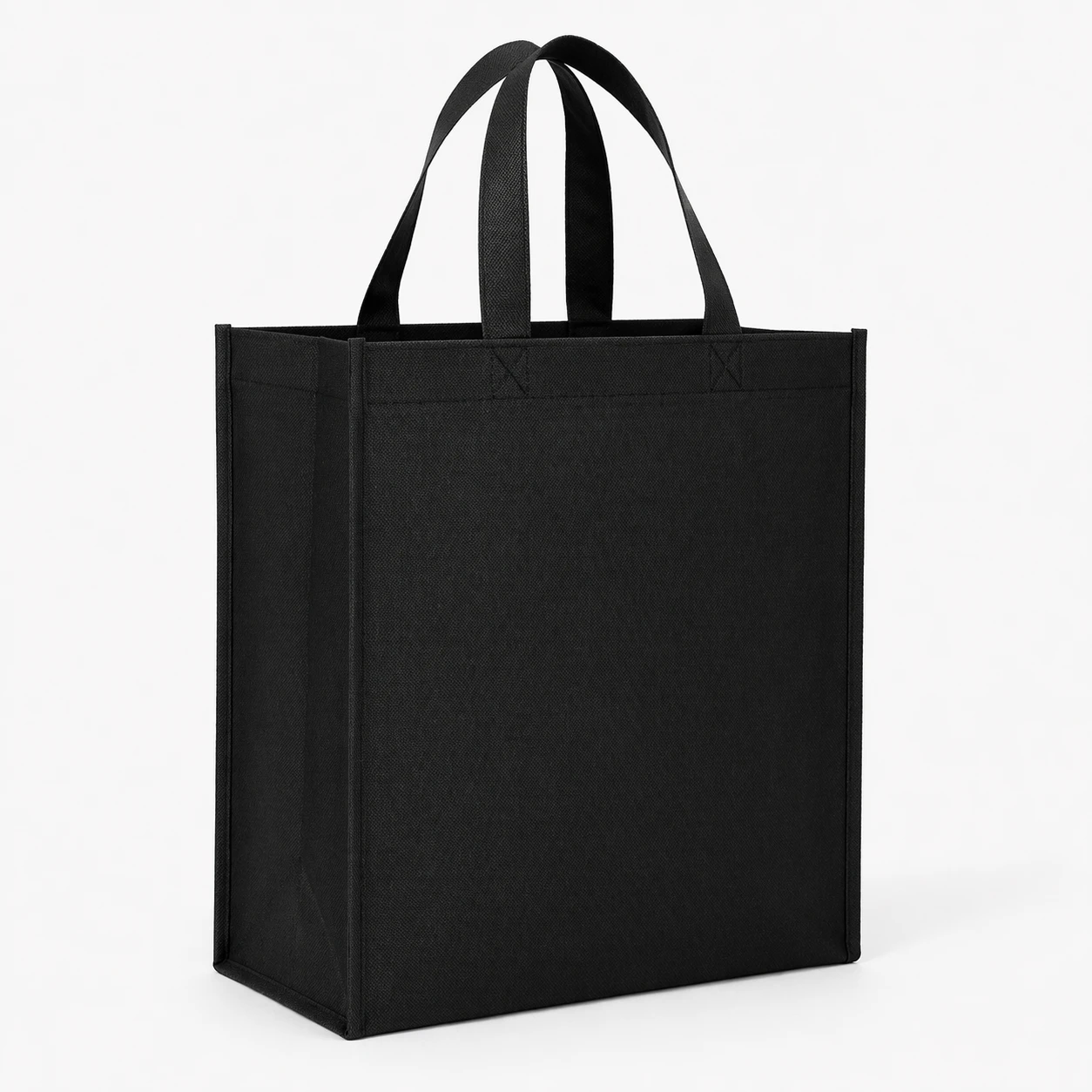
Buying in bulk? See our non-woven bags wholesale, made at our Govandi, Mumbai factory with pan-India delivery.
Thane's retail market is one of the busiest in the Mumbai Metropolitan Region, running from the Naupada and Gaondevi shopping belts to the large residential-catchment retail clusters that have grown up around Ghodbunder Road, plus the Wagle Estate industrial and commercial pocket that adds a corporate and small-manufacturing dimension to the city's demand. Kalyan-Dombivli, just next door, brings its own dense mix of garment shops, kirana stores, jewellers, wholesale cloth traders, and the busy Kalyan APMC market. Between the two, there is a genuine, steady demand for custom-printed carry bags that has no dedicated local supplier guide pointing shop owners and distributors toward a factory-direct source.
This guide is written for retail shop owners, wholesale distributors, garment and jewellery retailers, and small manufacturers based in Thane and Kalyan-Dombivli who currently buy bags through a local trader or middleman, and want to understand what ordering factory-direct from a Mumbai manufacturer actually looks like, in terms of pricing, minimum quantities, material choice, and turnaround. It also covers a regulatory point that matters more here than it might elsewhere: Maharashtra's ban on single-use plastic bags, and what a compliant alternative actually costs.
Why Thane and Kalyan-Dombivli Retailers Overpay Through Middlemen
A large share of the printed bags used by small and mid-size shops in Thane and Kalyan-Dombivli are bought from a local trader who has, in turn, bought them from a factory somewhere else and added a markup. For a shop owner ordering a few hundred bags a month, that markup usually shows up as a higher per-piece price, a longer wait if the trader needs to restock from their own supplier, and less control over exact colour, size or print placement, since you are choosing from whatever the trader happens to have in stock rather than specifying it yourself.
Ordering directly from a Mumbai factory removes that middle step. Thane and Kalyan-Dombivli are both close enough to our factory that sample delivery and, if needed, an in-person visit to check material quality before committing to a bulk order are realistic options, not a multi-day courier exercise. For a first-time buyer, this matters more than it sounds: seeing and feeling an actual sample bag, checking the stitching on the handles, and confirming the print colour matches your brand exactly, before signing off on a 1,000-unit order, avoids a class of dispute that is far more common when ordering sight-unseen from a distant supplier over WhatsApp photos alone.
The Maharashtra Plastic Ban and What It Means for Your Bag Choice
Maharashtra has enforced a ban on single-use plastic carry bags since 2018, covering plastic bags below a certain thickness regardless of whether they are branded or plain. Retailers across Thane and Kalyan-Dombivli who are still relying on thin plastic bags, or on a supplier who quietly still provides them, carry a real compliance risk, since enforcement drives and fines do happen periodically in both municipal areas. Switching to a compliant alternative is not just an environmental gesture in this market, it is a practical requirement.
Non-woven bags, cloth bags, jute bags and paper bags are all standard compliant alternatives, and each suits a different type of retail counter. A grocery or kirana store moving high volumes of low-value transactions usually wants the cheapest compliant option that still holds weight without tearing, which typically means a non-woven D-cut or W-cut bag at a moderate GSM. A garment or jewellery retailer, where the bag doubles as part of the customer's in-store experience, usually wants a better finish, which might mean a heavier GSM non-woven loop-handle bag, a cotton or canvas tote, or a printed paper bag with rope handles for a premium counter. Understanding this trade-off before you order in bulk saves a reprint later.
Non-Woven Bags for Retail Counters and Wholesale Distribution
Non-woven bags remain the most common request from retail and wholesale buyers in this belt, since they hold up to daily counter use, take a clean single or multi-colour print, and cost less per piece than cotton or canvas at comparable durability. Our non-woven bags range includes loop-handle bags, ideal for garment and general retail counters where a customer will carry the bag by hand for a reasonable distance, D-cut bags, a popular low-cost option for grocery and kirana stores where volume matters more than finish, and W-cut bags, which are a common choice for supermarket-style checkout counters that need a bag that stands upright and holds a heavier, mixed-item load.
Pricing varies by GSM, which is the measure of fabric thickness and directly affects both cost and durability, as well as by print complexity and order size. A lighter GSM bag costs less per piece but is better suited to lighter goods, while a heavier GSM bag costs more but can carry groceries, hardware, or multiple garments without stretching or tearing at the seams. Our Non-Woven Bags Wholesale Price in Mumbai guide breaks down typical rates by bag type and GSM in more detail, along with guidance on what GSM to choose for a shop counter bag versus a heavier-duty distribution bag, and is worth reading in full before you finalise a specification.
Retail Shopping Bags for Garment, Jewellery and General Stores
Kalyan-Dombivli's garment and jewellery retail cluster in particular tends to want a slightly better finish than a plain non-woven bag, since the bag itself is part of a customer's shopping experience at a mid-to-premium store, and a flimsy or poorly printed bag can undercut an otherwise good in-store experience right at the moment a customer leaves with their purchase. Our retail shopping bags range covers canvas and cotton totes as well as non-woven options, and our designer bag collection offers a boutique-grade finish for stores that want their carry bag to read as premium rather than purely functional, with options like designer canvas totes and designer retail carrier bags for shops that sell higher-ticket items where presentation matters at the point of sale.
Our general Retail Shopping Bags Wholesale guide is a good next read if you are comparing materials for the first time and want a broader view of what other retail categories across India typically order, beyond the Thane and Kalyan-Dombivli-specific context covered here.
Paper Bags for Premium Retail Counters and Gifting
A segment of Kalyan-Dombivli and Thane's retail market, particularly jewellers, boutiques, and gifting shops, increasingly wants a paper bag rather than a fabric one for the final point-of-sale handover, since a well-finished paper bag with rope handles reads as more premium and gift-appropriate than a cloth tote for certain product categories. Our paper bags range includes matte-finished and gold-foil options, both with rope handles, suited to jewellery counters, boutique retail, and festival or wedding-season gifting handovers where the bag is meant to look considered rather than purely functional.
Jute Bags for a Premium, Eco-Positioned Retail Look
A growing number of Thane and Kalyan-Dombivli retailers, particularly in the organic food, boutique and gifting space, are moving toward jute bags to signal an eco-conscious brand position to customers, which also aligns naturally with the compliance angle covered above, since jute is one of the most visibly "sustainable" materials available to a retailer positioning themselves this way. Our jute bags range includes plain, laminated and printed options, and typically runs at a higher per-piece cost than non-woven, in exchange for a distinctly premium look and better reusability, since a well-made jute bag tends to get reused by the customer multiple times rather than discarded after one use, extending your brand's visibility well past the original purchase.
If durability and repeated customer reuse matter more to your store than the lowest possible unit cost, jute is worth comparing directly against non-woven before you commit to a bulk print run. A useful way to think about it: non-woven wins on upfront cost per bag, jute wins on cost per customer impression if the bag gets reused ten or twenty times after the sale.
Corporate and Industrial Buyers in Thane's Wagle Estate
Thane is not purely a retail market. The Wagle Estate industrial and commercial belt houses a real mix of small manufacturers, trading companies, and corporate offices that generate their own bulk bag demand, separate from the retail-counter use case covered above. Employee joining kits, corporate gifting sets for client appreciation, and branded non-woven bags for exhibitions or product launches are all common requests from this segment. Our corporate gifting range and employee welcome kit collection cover this side of Thane's demand, and if your business sits in this category rather than pure retail, our companion guide on corporate bags for Navi Mumbai covers the same buyer profile in more depth, since the two markets overlap closely in what they order.
Seasonal Demand: Ganeshotsav, Diwali and Wedding Season
Thane and Kalyan-Dombivli both have a strong Ganesh Chaturthi culture, and retailers across both cities see a genuine seasonal spike in demand for gifting bags, modak and prasad packaging, and festival-themed retail carry bags in the weeks leading up to the festival. Diwali brings a second, larger spike, this time centred on corporate and retail gifting bags rather than festival-specific packaging. Wedding season, which runs heavily through the winter months in this region, drives demand for return-gift bags among garment and gifting retailers specifically.
If your store or distribution business sees a predictable seasonal pattern like this, it is worth placing your bulk order 30 to 45 days ahead of the peak selling window rather than ordering reactively once the season has already started, since production and print runs take real time and a rushed reorder mid-season usually costs more per piece and risks running out of stock at the worst possible moment.
How Bulk Ordering Actually Works, Step by Step
For a first-time buyer, the process typically runs as follows. First, you confirm the bag type, size, material and GSM based on what you are packing and how it will be handled, using the guidance above or a conversation with our team if you are unsure. Second, you confirm your logo or print artwork, ideally as a vector file, though our team can also work from a clear raster image if that is what you have. Third, we quote pricing based on your exact specification and quantity, since the ranges mentioned in this guide are indicative and the real number depends on your final spec. Fourth, once you approve the quote, we typically produce a physical sample for your review before the full production run begins, particularly for first-time orders, which is one of the practical advantages of ordering from a factory close enough for a same-day sample delivery. Fifth, once the sample is approved, the full batch goes into production, with standard turnaround depending on order size and print complexity.
Ordering for a Distributor or Multi-Shop Chain
If you are a distributor supplying bags to several retail outlets across Thane and Kalyan-Dombivli rather than a single shop owner, it is usually more cost-effective to consolidate what would otherwise be several smaller orders into one larger production run, even if the individual shops need different print details. We can run a shared base bag design with shop-specific print variations in a single batch, which keeps per-unit pricing closer to a large-volume rate than treating each shop as a separate small order. This is a common request from distributors supplying a chain of five to fifteen shops across the Kalyan-Dombivli belt, where each shop wants its own name and phone number on the bag but the underlying bag size, material and base design can be identical.
A Practical Example: What a Mid-Size Garment Retailer Might Order
To make the numbers concrete, consider a hypothetical mid-size garment retailer in Kalyan operating two shop locations. A typical first order for a business at this scale might be 1,000 non-woven loop-handle bags at a moderate GSM, single-colour print with the shop name and phone number, split across two sizes to cover both small accessory purchases and larger garment purchases. A second, smaller order of 200 to 300 premium paper bags with gold-foil printing might be reserved specifically for higher-ticket purchases like sarees or wedding-wear, where the customer experience of receiving a nicer bag matters more. This kind of two-tier approach, a high-volume everyday bag plus a smaller premium option for bigger purchases, is a pattern we see often among garment and jewellery retailers in this belt, and it is worth considering rather than ordering a single bag type for every transaction.
Common Mistakes First-Time Bulk Buyers Make in This Market
A few patterns show up repeatedly among first-time bulk buyers from Thane and Kalyan-Dombivli, and knowing them ahead of time can save a wasted print run. The most common mistake is choosing a GSM based purely on price rather than on what the bag will actually carry, which results in bags that tear or sag within a few uses and a customer left holding a spilled purchase, an experience that reflects poorly on the shop rather than the bag itself. A second common mistake is finalising artwork without checking how a logo prints at the bag's actual size, since a design that looks fine on a screen can end up cramped or off-centre on a small drawstring pouch versus a larger tote. A third is underestimating seasonal demand and placing a reorder only once existing stock has already run out, which leaves a shop without bags during exactly the week that Ganeshotsav or Diwali gifting traffic is at its peak.
A fourth, less obvious mistake is treating every bag order as identical when a business actually has two or three distinct use cases, such as a daily low-value transaction bag and a premium bag for bigger purchases, as covered in the garment retailer example above. Buyers who plan for this upfront, rather than realising it after the first order arrives, tend to get a better outcome from their first bulk purchase and a clearer sense of what to reorder going forward.
Comparing Non-Woven, Jute, Canvas and Paper for Thane and Kalyan-Dombivli Retail
With four realistic material options on the table for this market, it helps to compare them directly rather than pick one in isolation. Non-woven is the default choice for volume and cost efficiency, suits daily-use retail and wholesale counters, and is available in the widest range of styles through our non-woven bags line. Jute costs more per piece but signals an eco-conscious brand position and tends to get reused by customers multiple times, making it a better fit for boutiques, organic food stores, and gifting-focused retailers than for high-volume kirana counters. Canvas and cotton totes, available through our retail shopping bags range, sit between non-woven and jute on cost, and suit retailers who want a washable, long-lasting bag customers will genuinely keep using, such as fashion boutiques building repeat-visit brand recognition. Paper bags, through our paper bags collection, are the right choice specifically for the final handover moment at a jewellery counter or premium gifting shop, where the bag is part of a one-time presentation rather than an everyday carry item.
None of these four is universally "best." The right choice depends on transaction value, how often a customer will reuse the bag, and whether the bag needs to survive daily wholesale handling or simply look good for the ten minutes between purchase and the customer reaching home. Many of our repeat buyers in this belt end up ordering two materials rather than one, once they have run through a full season and seen which use case each material actually serves.
Pricing and MOQ Snapshot
MOQ for most non-woven and retail bag categories starts at 100 units, with meaningfully better per-piece pricing at 500 and 1,000-plus unit volumes, which suits a distributor consolidating multiple shop orders. Jute bags and paper bags typically start at a higher per-unit price than non-woven given the material cost, in line with the ranges covered in our other material-focused guides. For an exact quote against your bag size, GSM and print requirement, the fastest route is our contact form or a direct WhatsApp message with your specification.
Frequently Asked Questions
Do you supply to Thane and Kalyan-Dombivli directly, or only through local distributors?
We supply directly. Local traders can also buy from us as distributors if they want to keep supplying their existing shop network, but a shop owner or distributor is welcome to order factory-direct without going through an intermediary.
What is the minimum order for a single retail shop?
100 units is our standard minimum across most bag categories, which suits a single small shop's first order. Repeat orders at higher volumes get better per-unit pricing.
Are non-woven bags actually compliant with the Maharashtra plastic ban?
Yes, non-woven fabric bags are a standard compliant alternative to banned single-use plastic bags, along with cloth, jute and paper options. If you are unsure whether your current supplier's bags meet the applicable thickness and material standards, it is worth confirming directly rather than assuming.
Can different shops in a distributor's network each get their own print, in one combined order?
Yes, we can run a shared base design with shop-specific print variations within a single production batch, which is usually more cost-effective than several separate small orders.
How does non-woven GSM affect price and durability?
Higher GSM means a thicker, more durable fabric and a higher per-piece cost. Our non-woven pricing guide covers typical GSM choices for different retail use cases.
Should we order jute or paper bags instead of non-woven for a premium counter?
It depends on your product category. Jute suits an eco-positioned, reusable-bag strategy, while paper bags with gold-foil or matte finishing suit jewellery and gifting counters where presentation at the point of sale matters most. Both cost more per piece than non-woven.
How far ahead of a festival season should we place a seasonal bulk order?
30 to 45 days ahead of your peak selling window is a safe rule of thumb, given standard production and print turnaround. Ordering reactively once a season has already started usually costs more and risks running short of stock.
Can we visit the factory to check material quality first?
Yes, factory visits are welcome, and Thane and Kalyan-Dombivli are both a manageable distance from our Mumbai facility for a same-day visit.
Do you supply corporate or industrial buyers in Thane, not just retail shops?
Yes. Thane's Wagle Estate belt in particular has real corporate gifting and employee joining kit demand alongside the retail market covered in this guide.
If your business is based in Navi Mumbai or further along the port and logistics corridor, our companion guides on corporate bags for Navi Mumbai and delivery, cooler and warehouse bags for Panvel, Taloja and Uran cover those parts of the MMR region in more depth.