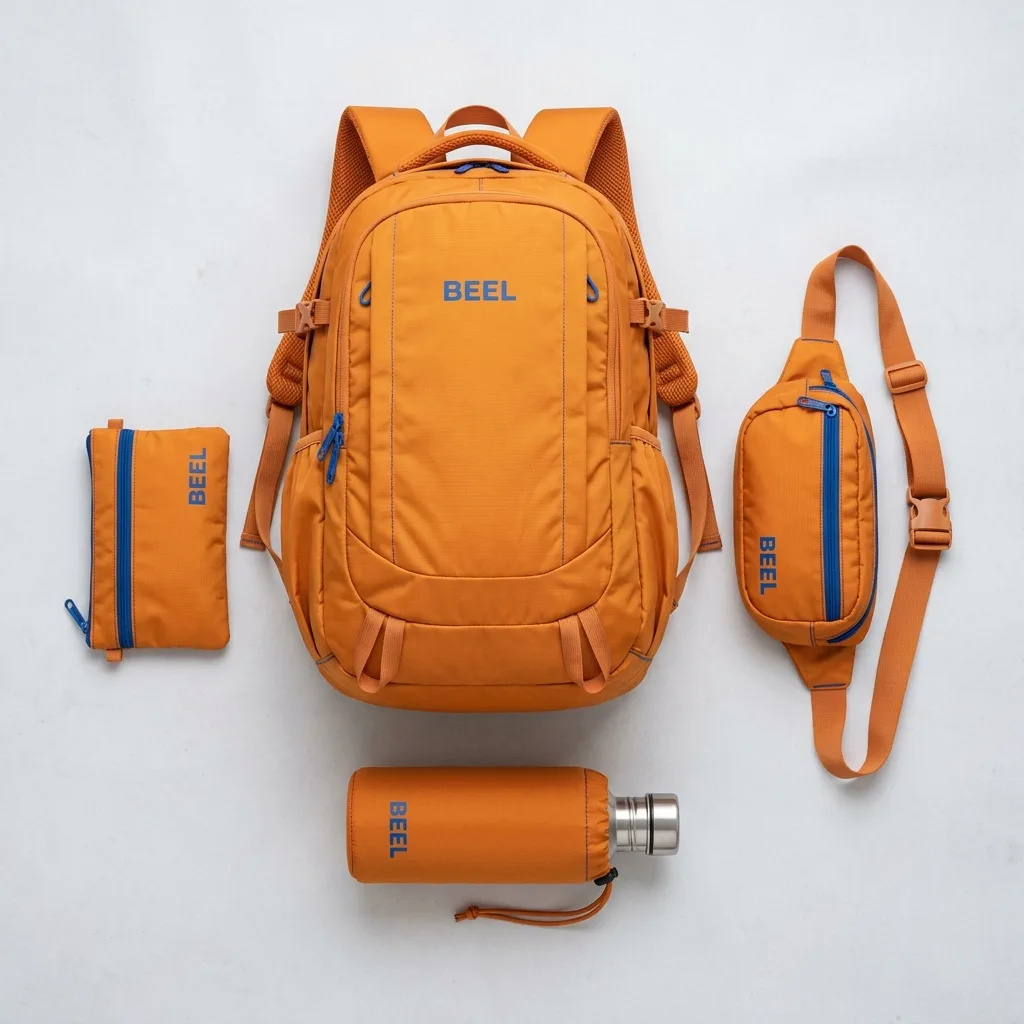
Buying in bulk? See our pilgrimage bags and yatra kits, made at our Govandi, Mumbai factory with pan-India delivery.
Every trekking pilgrimage season, tour operators and temple trusts across India put together kit bags for Char Dham, Kedarnath, Amarnath, Vaishno Devi, and Kumbh Mela groups: a backpack for the trek, a waist pouch for cash and phone, a rain cover for when the mountain weather turns. Most order these at the last minute, from whichever local vendor answers the phone first, and end up with mismatched bags, inconsistent branding, and stitching that doesn't survive a single circuit.
This guide is for anyone who books bulk Hindu yatra kits on a recurring basis: Char Dham and Amarnath tour operators, Vaishno Devi and Kedarnath travel agencies, and temple trusts running Kumbh Mela or Shirdi group travel. It covers what actually goes into a well-built trekking kit, how pricing works at different order sizes, and the questions worth asking a manufacturer before you commit to a season's worth of orders.
Why the Kit Bag Matters More Than Most Operators Realize
A yatra kit bag isn't just carrying capacity. For a tour operator, it does three jobs at once.
It keeps the group visible and identifiable. On a crowded route like Kedarnath or during Kumbh Mela, spotting your own group among tens of thousands of other pilgrims is a real logistical problem. A consistent bag color and printed group name solves this instantly, for guides and for pilgrims trying to find their own bus.
It becomes free advertising for the next season. A branded bag doesn't disappear after the trip. Pilgrims use it again for the next yatra, lend it to a relative, or keep it visible at home. Every reuse is a small, free reminder of who ran the tour.
It protects the pilgrim, and by extension your reputation. A backpack that rips on a mountain trail or a strap that snaps mid-climb becomes the operator's problem, not the manufacturer's. Pilgrims remember the agency that handed them a bag that fell apart on day two of a five-day trek.
Despite this, packaging is usually the last thing booked and the first thing cut when a season gets busy. That's usually a mistake, because the price difference between a properly built kit and a cheap one is small relative to the total tour cost, but the difference in group experience is not.
What Goes Into a Proper Char Dham or Hindu Yatra Kit
Mountain and trekking pilgrimages need a completely different kit than air travel or city-based pilgrimages. These routes involve altitude, cold, sudden rain, and multi-day walking, so every item has to earn its place.
A 45 to 55 litre trekking backpack with padded shoulder straps and a chest strap for weight distribution. This is the core piece, and it's also the one most operators under-spec. A backpack built for a college trip won't survive repeated multi-day use on a rocky trail. See our full range of tour and travel bags for sizing and fabric options beyond the standard yatra spec.
A waist belt pouch for medication, phone, cash, and quick-access items pilgrims need without stopping to dig through the main pack. Worn over layers of warm clothing, so it needs an adjustable strap long enough to fit comfortably.
An insulated bottle holder to keep water or herbal tea warm in cold mountain weather, with a shoulder strap so it doesn't take up hand space on narrow trail sections.
A waterproof dry bag or organizer to keep a spare set of clothes dry through sudden mountain downpours, which are common and fast-moving on routes like Amarnath and Kedarnath.
A rain cover, either built into the backpack or supplied separately, since carrying an umbrella isn't practical on a trekking route and ponchos alone don't protect the pack's contents.
Saffron and orange are the standard color choices for this category, partly for tradition and partly because they're genuinely easier to spot on a crowded trail or in a large group photo used for headcounts.
Materials: What Actually Holds Up on a Mountain Route
Kit bags fail for one of two reasons on these routes: the wrong fabric for the altitude and weather, or stitching that wasn't built for repeated hard use across multi-day walking.
Look for water-resistant polyester or nylon rated for outdoor use, not a lightweight fabric that's fine for a city day bag but tears on rocky terrain or in dense forest sections. Denier rating matters here: anything below 300D tends to show wear within a single season of heavy trekking use.
Seams matter as much as the fabric itself. A bag that's been reinforced at stress points, strap joints, base corners, zipper ends, will survive a multi-day yatra where a standard-stitched bag won't. Ask specifically whether base corners are double-stitched or bar-tacked, since that's usually where a cheaply made backpack fails first, under the weight of a full pack set down repeatedly on rocky ground.
Zippers should be a heavier gauge than what you'd find on a normal daypack, since cold fingers and wet conditions put more strain on a small zipper pull than most manufacturers account for.
A quick way to check a supplier's claims: ask for one sample kit before committing to the season's volume, and actually use it, stuff it, zip and unzip it fifty times, get it wet, and set it down on a rough surface repeatedly. A kit that survives a week in someone's hands tells you more than any spec sheet.
MOQ and Pricing: What to Expect
Yatra kits are typically quoted per set (the full kit, not individual pieces), and most manufacturers set a minimum order around 100 sets per season or per group departure. Pricing for a full custom-branded Char Dham or Hindu yatra kit generally starts around Rs. 550 per set at the 100-unit tier, with per-unit cost dropping as volume increases, since setup and printing costs get spread across more units.
| Kit Configuration | Typical Contents | Price per Set (100 to 249 sets) | Price per Set (500+ sets) |
|---|---|---|---|
| Full trekking kit | Backpack, waist belt, bottle holder, dry bag, rain cover | Rs. 550 to Rs. 800 | Rs. 400 to Rs. 600 |
| Standard kit | Backpack, waist belt, bottle holder | Rs. 420 to Rs. 600 | Rs. 310 to Rs. 460 |
| Basic two-piece kit | Backpack plus one accessory pouch | Rs. 250 to Rs. 380 | Rs. 180 to Rs. 280 |
Prices are ex-Mumbai factory, exclusive of GST and shipping, and vary with fabric grade, print colors, and exact item selection. Get a quote for your exact kit mix rather than budgeting off a generic range.
A few things move the price up or down beyond volume:
Item count per kit. A basic two-piece kit costs less than a full five-piece kit with a dry bag and rain cover added.
Fabric grade. Standard-weight polyester costs less than a heavier, fully water-resistant grade, though the price difference is usually smaller than operators expect, often just 10 to 15 percent, for a meaningfully more durable bag on a route where durability actually matters.
Print complexity. A single-color logo on each piece is the cheapest option. Multi-color prints or embroidery instead of screen printing add setup cost, particularly at lower volumes where that setup cost isn't spread as thin.
Custom item selection. Reputable manufacturers will let you swap items in or out of a standard kit template rather than forcing a fixed bundle. If your route doesn't need a rain cover because you're running a shorter, lower-altitude circuit, you shouldn't have to pay for it.
Custom Branding: What Actually Works on a Yatra Kit
Printing on a yatra kit does more work than a logo on a corporate tote, because pilgrims genuinely use these bags for years afterward, often on future trips or lent to family members. A few practices consistently work better than others.
Print the group or batch number, not just the agency name. On a large multi-bus departure, a batch number printed alongside the logo makes it much faster for group leaders to sort pilgrims at toll stops, base camps, and hotel check-ins along the route.
Keep contact information on the bag itself. A phone number or emergency contact printed on the backpack means a lost bag, or a pilgrim who gets separated from the group, can be identified and reconnected faster. This has real practical value on crowded routes like Kumbh Mela where headcounts happen constantly.
Print in Hindi (Devanagari), not just English. Most pilgrims on these routes read Hindi more comfortably than English, and a logo or instruction they can actually read on sight, rather than translate, defeats the purpose less.
Screen printing is the standard for most kit pieces, since it's durable and cost-effective across large runs and holds up against repeated exposure to rain and dust. Embroidery is worth the extra cost only on the backpack itself, where a stitched logo reads as higher quality and survives longer than a printed one under constant strap friction.
Timing: Order Before the Season, Not During It
This is the mistake that costs operators the most, not in money but in group experience. Char Dham Yatra runs roughly May through November, with the heaviest booking volume concentrated in the May to July window. Kumbh Mela and major melas are scheduled years in advance, which gives temple trusts no excuse for last-minute ordering, yet it happens constantly.
Manufacturers see order volume spike in the weeks right before each season opens, which means production queues get longer and customization options get more limited exactly when operators need them most. Placing your order six to eight weeks before your first group departure, rather than two weeks before, gives you room for a sample approval cycle, a production run, and a buffer for shipping delays, none of which you have if you're ordering the week your first group leaves.
If you run multiple departures across a season, it's worth ordering your full season's volume in one batch rather than reordering per group. You lock in a single price tier, avoid repeated setup charges, and don't risk a fabric or color mismatch between early-season and late-season batches from two different production runs.
Questions Worth Asking Before You Order
A few questions separate a manufacturer who understands trekking pilgrimage logistics from one who's just printing bags:
Can items be swapped in or out of a standard kit, or is the bundle fixed? Can you get a single sample kit before committing to the full order, and how long does that sample take to arrive? What's the actual fabric denier and water-resistance rating, not just a marketing description? What's the realistic production and delivery timeline against your season's start date? And can printing be done in Hindi as well as English, on every piece of the kit, not just the main backpack?
A supplier who answers these clearly, with specifics rather than reassurance, is usually the one whose bags will still be intact halfway through the season.
Frequently Asked Questions
What is the minimum order for Char Dham and Hindu yatra kits?
At BEEL Bags, the minimum order is 100 sets. You can mix item configurations within the same order if different departures need slightly different kits.
Can we choose exactly which items go into each kit?
Yes. The standard kit template is a starting point, not a fixed bundle. You can add, remove, or swap items to match your specific route and altitude.
How long does production take?
Once artwork is approved, production typically runs 10 to 15 days depending on order size and item complexity, followed by pan-India shipping. Ordering six to eight weeks ahead of your first departure gives comfortable buffer for sampling, production, and transit.
Do you print in Hindi and other regional languages?
Yes. We print in Devanagari, English, and most regional Indian languages, and can run mixed-language prints where a kit needs more than one script.
What fabric do you recommend for high-altitude routes like Amarnath and Kedarnath?
For routes above 3,000 metres or with significant rain exposure, we recommend a minimum 300D water-resistant polyester with a taped or sealed base seam. Happy to walk through fabric options against your exact route on a call.
Do you supply kits for repeat, multi-batch seasonal orders?
Yes, this is common for larger tour operators running several departures across a season. We can hold a fixed spec and price across the season so each batch matches the last.
Where BEEL Bags Fits
We manufacture Char Dham and Hindu yatra trekking kits at our Mumbai factory for tour operators and temple trusts, with a minimum order of 100 sets and full customization on which items go into each kit. If you run seasonal group travel to Char Dham, Amarnath, Vaishno Devi, or Kumbh Mela and want a kit built around your actual route rather than a generic template, you can see the full kit breakdown and request pricing here: Pilgrimage Tour Bags & Kits.
We also handle the surrounding categories tour operators tend to need alongside kit bags: printed non-woven bags for group welcome kits, and custom T-shirts for staff and guide identification. BEEL Bags' founding family has been manufacturing from our Mumbai factory since 1996, and you can request a quote here for your exact route and group size. If your agency also runs Hajj, Umrah, or international pilgrimage groups, read our dedicated guide to those kits here.