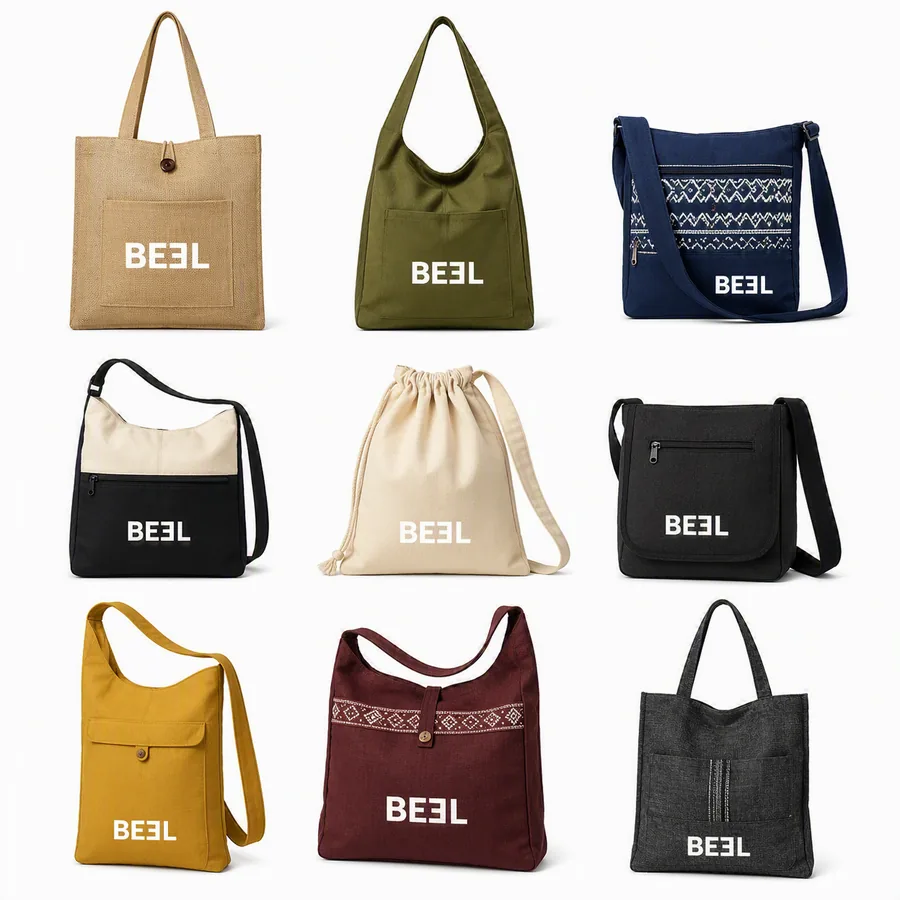
Most enquiries for custom tote bags reach us with one line: "Need 500 tote bags with our logo, what's the rate?" We can't answer that honestly without four more details, and by the time we've asked for them the buyer has already got three quotes that look cheaper. Some of those quotes are cheaper because they are for a thinner fabric, a smaller bag, or a print that will crack after ten washes.
This guide is the conversation we have on the phone every week, written down. It covers which fabric to choose, what each print method costs, real price bands by quantity, sizes that actually get used, and how long production takes at our Mumbai bag factory in Govandi. If you finish reading this, you'll be able to send a supplier a brief that gets you a quote you can compare line by line.
One note before we start. Every price below is a rough band from orders we have quoted in 2026. Cotton yarn and jute rates move every few months, so treat these as a starting point, not a final number.
What buyers mean by a custom tote bag
A tote is an open-top bag with two parallel handles, usually flat or with a small gusset at the base. "Custom" can mean three different things, and it helps to know which one you need because each changes the price and the minimum order.
- Custom print only: our standard bag in a stock colour, with your logo printed on one or both sides.
- Custom colour and print: fabric dyed or sourced in your brand shade, plus your artwork.
- Fully custom: your own size, gusset, handle length, inner pocket, zip, label and packing.
For a first order of a few hundred bags, the first option is almost always the sensible one. A fully custom bag only starts making sense around 1,000 pieces, because pattern making, sampling and fabric buying for a one-off size all add fixed cost that has to be spread over the run.
Choosing the fabric for your tote
Fabric decides about 60 to 70 percent of what you pay, so this is the first decision to get right. We make totes in five main materials. The table below compares them on weight, feel, print quality and where each one fits.
| Fabric | Typical weight | Feel and life | Best print method | Where it works |
|---|---|---|---|---|
| Cotton (calico or poplin) | 120 to 180 GSM | Soft, foldable, 1 to 2 years of regular use | Screen print, DTF | Events, campus, pharma launches, retail |
| Canvas (cotton) | 8 oz to 12 oz (roughly 270 to 410 GSM) | Stiff, holds shape, 3 years or more | Screen print, embroidery | Corporate gifts, premium retail, D2C brands |
| Jute (natural or laminated) | Around 300 to 400 GSM hessian | Rough texture, very strong, does not fold flat | Screen print | Grocery, wedding gifts, export retail |
| Non-woven polypropylene | 70 to 120 GSM | Light, cheap, a few months to a year | Screen print, offset on laminated | High-volume giveaways, shop carry bags |
| rPET (recycled polyester) | Around 80 to 150 GSM | Smooth, water resistant, folds small | Screen print, sublimation on white | Sustainability campaigns, foldable shoppers |
A quick way to read canvas weights: 1 oz per square yard is about 34 GSM, so a 10 oz canvas is close to 340 GSM. Some sellers quote canvas in oz and cotton in GSM on the same sheet, which makes the canvas look heavier than it is next to a 180 GSM cotton. Ask for both numbers.
Cotton or canvas
This is the choice most corporate buyers struggle with. A 140 GSM cotton bag is light enough to fold into a conference kit and costs roughly half of a canvas tote. It also looks a bit limp in photos. A 12 oz canvas tote bag stands up on a table, survives a laptop and a water bottle, and is the kind of bag people still carry two years later. If the bag is the gift, pay for canvas. If the bag is the packaging for the gift, cotton is fine.
We wrote a longer comparison of the three natural fabrics in non-woven vs jute vs canvas bags, and a separate piece on choosing a cotton bags manufacturer in India if you want to go deeper on yarn counts and weaves.
When jute makes more sense
Jute totes carry heavy loads. A grocery shopper or a wine bottle holder in jute will outlast almost anything else in this list. Plain jute sheds a little fibre, so for retail and gifting we usually suggest a laminated jute bag, which has a thin coating on the inside that keeps it clean and gives a sharper print. Prices for plain and laminated jute by size are in our jute bags wholesale price post.
Custom tote bag prices by quantity
Here's the table most people scroll down to first. These are per-piece bands for a mid-size tote (around 14 x 16 inches for cotton, 15 x 17 inches with a gusset for canvas and jute) with a one-colour logo on one side. GST and freight are extra.
| Bag type | 100 pcs | 500 pcs | 1,000 pcs | 5,000 pcs |
|---|---|---|---|---|
| Cotton tote, 140 to 160 GSM | Rs 70 to 95 | Rs 50 to 65 | Rs 42 to 55 | Rs 36 to 46 |
| Canvas tote, 10 to 12 oz, with gusset | Rs 190 to 250 | Rs 135 to 175 | Rs 115 to 150 | Rs 100 to 130 |
| Laminated jute tote, cotton handles | Rs 160 to 220 | Rs 115 to 150 | Rs 100 to 130 | Rs 85 to 110 |
| Non-woven tote, 90 to 100 GSM | Not practical | Rs 22 to 32 | Rs 18 to 27 | Rs 14 to 22 |
| rPET foldable tote | Rs 95 to 130 | Rs 65 to 90 | Rs 55 to 78 | Rs 48 to 66 |
The jump from 100 to 500 pieces is the steepest drop on every row. At 100 pieces, screen setup, cutting-table setup and the first hour of machine adjustment sit on very few bags. Past 1,000 pieces the curve flattens, and from there your savings come mostly from fabric bought by the roll instead of by the metre.
If a quote is well below these bands, check three things before you celebrate: the GSM written on the quote, the finished size including gusset, and whether the price includes printing on both sides or just one. Our bulk pricing page has tier rates across our other product lines, and the minimum order quantity page explains why the MOQ differs from one bag to another.
What pushes the price up or down
Once fabric and quantity are fixed, a handful of other choices move the rate. This table shows the usual effect of each one on a 500-piece cotton or canvas order.
| Choice | Typical effect on price per bag | Our view |
|---|---|---|
| Print on both sides instead of one | Adds Rs 5 to 12 | Worth it for retail and events, the bag gets seen from both sides |
| Each extra print colour | Adds Rs 4 to 10 plus a new screen | Two colours is the sweet spot for most logos |
| Dyed fabric instead of natural | Adds 10 to 20 percent | Black, navy and olive are stocked, Pantone matching needs 1,000+ pcs |
| Base gusset of 3 to 5 inches | Adds Rs 6 to 15 | Needed for groceries, books or boxed gifts |
| Inner pocket or zip closure | Adds Rs 10 to 30 | Good for corporate totes that carry phones and keys |
| Woven label or printed care label | Adds Rs 3 to 8 | Cheap way to make a tote look branded and finished |
| Individual polybag packing | Adds Rs 1.5 to 4 | Skip it for events, keep it for retail and export |
Print methods and what each costs
The print method matters as much as the fabric. A wrong choice here is the most common reason we see totes thrown away early: a large rubbery heat-transfer patch that peels at the corners, or a six-colour design squeezed into a screen print that blurs.
| Method | Setup cost | Running cost per print | Good for | Avoid when |
|---|---|---|---|---|
| Screen print | Rs 600 to 1,200 per colour per side | Rs 4 to 10 per colour | 1 to 4 colour logos, 300+ pieces | Photos and gradients |
| DTF (direct to film) transfer | None or very low | Rs 18 to 50 by print size | Full-colour art, 50 to 300 pieces | Very large prints on heavy canvas |
| Embroidery | Rs 500 to 1,500 digitising | Rs 20 to 60 for a 3 to 4 inch logo | Premium canvas totes, small logos | Light cotton below 160 GSM |
| Sublimation | Low | Rs 25 to 60 | All-over prints on white polyester or rPET | Cotton, jute or dark fabric |
| Offset print on laminated film | Plate cost, high | Low at volume | Laminated non-woven at 5,000+ pieces | Small runs |
On our floor, screen printing still handles most tote orders. Our screen printed bags use plastisol or water-based inks depending on the fabric, and a one-colour job on 1,000 cotton totes takes our printing table roughly a day and a half including drying. DTF has become popular for short runs because there is no screen, but the print sits on top of the fabric and you can feel it. For a corporate gift we would rather do two-colour screen print or move to embroidered bags for a small chest-style logo.
Artwork tip from our designer: send vector files (AI, PDF or SVG) with fonts converted to outlines. A logo copied off a website at 300 pixels wide will print soft at 10 inches, and we will have to redraw it, which adds a day.
For a wider look at logo work across all our products, see logo printed bags and our older post on custom printed bags for business.
Tote sizes and what each one is used for
Buyers often ask for "standard size." There isn't one. The table lists the five sizes we cut most often and what they usually carry. Sizes are width x height, plus gusset where mentioned.
| Size (inches) | Size (cm, approx.) | Handle | Typical use |
|---|---|---|---|
| 12 x 14, flat | 30 x 36 | 12 to 14 inch hand handle | Pharmacy samples, cosmetics, small retail |
| 14 x 16, flat | 36 x 41 | 22 to 24 inch shoulder | Conference kits, college fests, A4 documents |
| 15 x 17 with 4 inch gusset | 38 x 43 x 10 | 24 to 26 inch shoulder | Retail shoppers, books, laptop up to 14 inch |
| 16 x 14 with 6 inch gusset | 41 x 36 x 15 | Short rope or webbing | Grocery, wine bottles, gift hampers |
| 18 x 15 with 5 inch gusset | 46 x 38 x 13 | 26 inch shoulder | Beach and travel totes, weekend bags |
If the tote will hold an A4 folder, the inside width must be at least 13 inches after stitching. We lose about half an inch each side to seams, so a 13 inch bag is too tight. This sounds obvious, but we have seen event agencies order 12,000 bags in the wrong size because the sample was checked empty.
Handle length is not a detail
A 22 inch handle (measured end to end) lets most adults carry the bag on the shoulder over a shirt. Go to 24 or 26 inches if people will wear jackets, which matters for export orders to the UK or Europe. Short 12 to 14 inch handles look neat on a retail counter but are tiring to carry for more than a few minutes. For jute bags we usually fit padded cotton rope or webbing, since flat jute handles cut into the palm.
Who orders custom tote bags, and what they usually pick
After 30 years of orders, patterns repeat. The same buyer type tends to land on the same spec, and it saves time to start from what has worked for others in your position.
| Buyer | Typical quantity | Common spec | Budget per bag |
|---|---|---|---|
| Event and conference organisers | 300 to 3,000 | 14 x 16 cotton or non-woven, one-colour print, sponsor logos on back | Rs 25 to 70 |
| Corporate HR and gifting teams | 100 to 1,000 | 12 oz canvas with gusset, embroidery or two-colour print, inner pocket | Rs 150 to 350 |
| Retail stores and supermarkets | 1,000 to 20,000 | 15 x 17 cotton or laminated jute, store name both sides | Rs 40 to 130 |
| D2C and fashion brands | 200 to 2,000 | Dyed canvas or premium cotton, woven label, individual packing | Rs 120 to 300 |
| Schools, NGOs and CSR programmes | 500 to 10,000 | Cotton or rPET, simple print, sturdy stitching | Rs 35 to 90 |
| Importers in UAE, UK, USA, Europe | 1,000 to 10,000 | Canvas or jute, private label, carton marking to spec | Quoted in USD or EUR |
Event teams should look at our conference tote bag and the broader bags for events range. Shop owners will find carry bag options on bags for retail stores. HR teams usually end up pairing a tote with other items, and our corporate gifting kits are built that way. For tight budgets, our list of corporate gift ideas under Rs 500 shows where a tote fits alongside bottles and diaries.
Brands selling under their own name can ask for private label bags with their woven label and no trace of BEEL anywhere on the bag or carton. Buyers outside Mumbai do not need to visit; we ship to Bengaluru, Delhi, Hyderabad and the rest of India every week, and our Bangalore page covers how that works for tech companies there.
Production time from approval to dispatch
Lead time depends on quantity, fabric availability and how quickly the artwork is approved. These are working days from sample approval and advance payment, for natural or stocked-colour fabric.
| Stage or order size | Working days | What happens |
|---|---|---|
| Digital mockup | 1 | Logo placed on bag photo with size marked in inches |
| Physical sample | 3 to 5 | One printed bag in actual fabric, courier extra outside Mumbai |
| 100 to 500 pieces | 8 to 12 | Cutting, printing, stitching, checking, packing |
| 1,000 to 3,000 pieces | 12 to 18 | Same steps across two or three stitching lines |
| 5,000 to 10,000 pieces | 20 to 30 | Fabric booked from mill, part dispatches possible |
| Custom-dyed fabric | Add 7 to 12 | Dyeing and colour approval before cutting |
October to December is our busiest stretch because of Diwali gifting, wedding season and year-end conferences. If your event is in that window, book production a month ahead. We have turned around rush jobs of 1,000 cotton totes in six working days, but only when fabric was already on the shelf and the artwork was final on day one.
How we check quality before a tote leaves the floor
A tote has very few parts, so the failures are predictable. Handles tear off at the stitch, prints crack, or the bag comes out a centimetre narrower than the sample. Here is what our checkers look at on every batch.
- Handle attachment: box-cross stitch (an X inside a square) on canvas and jute, double stitch on cotton.
- Seams: overlocked or bound inside so threads don't fray after washing.
- Print position: measured from the top edge on a sample of bags from every bundle.
- Print cure: a scratch and stretch test on screen prints after drying.
- Size: finished bag measured against the approved sample, not against the drawing.
- Load test: a sample filled with 5 to 8 kg and lifted by the handles, depending on fabric.
More detail on our inspection steps is on the quality control page. If you are ordering a large run, ask for photos from the packing table before dispatch. We send them on WhatsApp as a matter of routine.
Mistakes that make a cheap tote expensive
We'd rather lose an order than watch a buyer make one of these, because the bag ends up in a cupboard and the brand money is wasted.
- Ordering 100 GSM cotton for a bag meant to carry a laptop. It will sag and tear within weeks.
- Choosing a print bigger than the flat area. On a gusseted bag, the printable area is smaller than the bag size.
- Approving artwork on a screen without a physical sample. Colours on cotton print duller than on a phone.
- Forgetting the back. A blank back is a missed impression at every event or store visit.
- Splitting one order across four sizes to "keep options open." Each size has its own setup, so the rate goes up.
- Not asking about wash life. Ask the supplier how many home washes the print is tested for.
If sustainability is part of your brief, think about what the bag replaces. A heavy canvas tote only beats a lighter bag on footprint if people reuse it many times, so pick a design people will want to carry. Our posts on rPET bags in India and recycled PET bags cover the recycled options if that matters to your buyers.
How to order custom tote bags from us
The process is the same for 200 bags or 20,000. Sending all of this in your first message usually gets you a firm quote the same day.
- Share quantity, fabric preference, size, print colours and your deadline on WhatsApp or through our contact page.
- Send your logo as a vector file. If you only have a JPG, send the largest one you have.
- We reply with a quote and a digital mockup within 24 hours, often sooner.
- Approve the mockup and, for orders above 300 pieces, ask for a physical sample.
- Pay the advance (usually 50 percent) and confirm the sample. Production starts the next working day.
- We send photos and a packing list before dispatch, and the balance is paid before goods leave.
- Goods go by transport or courier anywhere in India, or by sea and air for export orders.
Frequently asked questions
What is the minimum order for custom tote bags?
For most cotton and jute totes our MOQ is 100 pieces. Our standard 12 oz canvas tote starts at 500 pieces. For smaller runs of 50 we can usually do DTF printing on a stock bag, though the rate per piece is higher.
How much does a printed cotton tote bag cost in India?
A 140 to 160 GSM cotton tote with a one-colour logo is roughly Rs 50 to 65 at 500 pieces and Rs 42 to 55 at 1,000 pieces, before GST and freight. Heavier cotton, more print colours and a gusset all add to that.
Which print lasts longest on a tote bag?
Embroidery lasts the life of the bag. Among prints, a well-cured screen print on cotton or canvas holds up through many washes. DTF transfers are good for full-colour art but can lift at the edges if the bag is washed hot or ironed directly.
Can you match our brand colour exactly?
Ink colours can be matched to a Pantone reference on any order. Matching the fabric colour itself needs dyeing, which is practical from about 1,000 pieces and adds 7 to 12 working days.
Do you make tote bags with zips and pockets?
Yes. Corporate canvas totes often get a top zip, an inner slip pocket and a key loop. Expect Rs 10 to 30 extra per bag depending on what you add.
Can you ship custom tote bags outside India?
We export regularly to the UAE, UK, USA and Europe. Export orders usually start at 1,000 pieces, with cartons marked to your warehouse format and private labels if you need them.
If you have a quantity and a date in mind, send them to us with your logo and we'll come back with a price, a mockup and an honest view on which fabric fits your budget. Fill in the form on our contact page or message us on WhatsApp at +91 86525 70502.